MCQ
If $E=a t+b t^2$, what is the temperature of inversion
  • $-\frac{a}{2 b}$
  • B
    $+\frac{a}{2 b}$
  • C
    $-\frac{a}{b}$
  • D
    $+\frac{a}{b}$

Answer

Correct option: A.
$-\frac{a}{2 b}$
(a) $E=a t+b t^2$ at inversion temperature $E$ will be minimumThus $\frac{d E}{d t}=0 \Rightarrow \frac{d}{d t}\left[a t+b t^2\right]=0$$\Rightarrow a+2 b t=0 \Rightarrow t=-\frac{a}{2 b}$

Need a full question paper?

Generate a complete, print-ready paper with questions like this in minutes — across 16+ boards, with answer keys.
Start Generating Free

Similar questions

Equal masses of water and a liquid of density 2 are mixed together, then the mixture has a density of
If the heart pushes $1 \mathrm{cc}$ of blood in one second under pressure $20000 \mathrm{~N} / \mathrm{m}$ the power of heart is
At $27^{\circ} \mathrm{C}$ a gas is suddenly compressed such that its pressure becomes $\frac{1}{8} t h$ of original pressure. Temperature of the gas will be $(\gamma=5 / 3)$
A man, standing between two cliffs, claps his hands and starts hearing a series of echoes at intervals of one second. If the speed of sound in air is $340 \mathrm{~ms}$, the distance between the cliffs is
A man of weight $80 kg$ is standing in an elevator which is moving with an acceleration of $6 m / s ^2$ in upward direction. The apparent weight of the man will be $\left(g=10 m / s ^2\right)$
On increasing the length by $0.5 mm$ in a steel wire of length $2 m$ and area of cross-section $2 mm ^2$, the force required is [ $Y$ for steel $\left.\left.=2.2 \times 10^{11} N / m ^2\right]\right]$
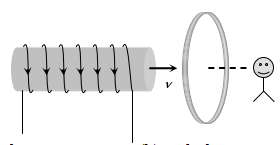
A current carrying solenoid is approaching a conducting loop as shown in the figure. The direction of induced current as observed by an observer on the other side of the loop will be
Image
Two perfectly elastic particles $P$ and $Q$ of equal mass travelling along the line joining them with velocities $15 \mathrm{~m} / \mathrm{sec}$ and $10 \mathrm{~m} / \mathrm{sec}$. After collision, their velocities respectively $($in $\mathrm{m} / \mathrm{sec} )$ will be
In dispersion without deviation
For an ac circuit $V=15 \sin \omega t$ and $I=20 \cos \omega t$ the average power consumed in this circuit is