MCQ
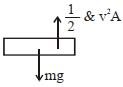
Karman line is a theoretical construct that separates the earth's atmosphere from outer space. It is defined to be the height at which the lift on an aircraft flying at the speed of a polar satellite $(8 \,km / s )$ is equal to its weight. Taking a fighter aircraft of wing area $30 \,m ^2$, and mass $7500 \,kg$, the height of the Karman line above the ground will be in the range .............. $km$ (assume the density of air at height $h$ above ground to be $\rho( h )=1.2 e ^{\frac{ h }{10}} \,kg / m ^3$ where $h$ is in $km$ and the lift force to be $\frac{1}{2} \rho v^2 A$, where $v$ is the speed of the aircraft and $A$ its wing area).
  • A
    $25-50$
  • $75-100$
  • C
    $125-150$
  • D
    $175-200$

Answer

Correct option: B.
$75-100$
b
(B)

For equilibrium :

$mg ^{\prime}=\frac{1}{2} \rho v ^2 A$

$mg \left(1-\frac{2 h }{ R }\right)=\frac{1}{2} \times 1.2 e ^{-\frac{ h }{10}} v ^2 A$

$\Rightarrow 7500 \times 9.8\left(1-\frac{2 h }{ R }\right)=0.6 e ^{-\frac{ h }{10}}\left(8 \times 10^3\right)^2 \times 30$

$\downarrow$ Neglect this term for a while and we get $h \simeq 95 \,km$

So, with $\left(1-\frac{2 h}{R}\right)$, we will get little lesser value or $h$.

$\therefore(B)$ is the answer.

Need a full question paper?

Generate a complete, print-ready paper with questions like this in minutes — across 16+ boards, with answer keys.

Start Generating Free

Similar questions

The temperature of a gas having $2.0 \times 10^{25}$ molecules per cubic meter at $1.38 \mathrm{~atm}$ (Given, $\mathrm{k}=$ $\left.1.38 \times 10^{-23} \mathrm{JK}^{-1}\right)$ is :
Displacement between maximum potential energy position and maximum kinetic energy position for a particle exciting $\text{S.H.M.}$ is:
An object is allowed to fall from a height $R$ above the earth, where $R$ is the radius of earth. Its velocity when it strikes the earth's surface, ignoring air resistance, will be :
In an elevator, a spring clock of time period $T_S$ (mass attached to a spring) and a pendulum clock of time period $T_P$ are kept. If the elevator accelerates upwards
Two particles of masses ${m_1}$ and ${m_2}$ in projectile motion have velocities ${\vec v_1}$ and ${\vec v_2}$ respectively at time $t = 0$. They collide at time ${t_0}$. Their velocities become ${\vec v_1}'$ and ${\vec v_2}'$ at time $2{t_0}$ while still moving in air. The value of $|({m_1}\overrightarrow {{v_1}} '\, + {m_2}\overrightarrow {{v_2}} ') - ({m_1}\overrightarrow {{v_1}} \, + {m_2}\overrightarrow {{v_2}} )$| is
If $| A + B |=| A |+| B |$ the angle between $\overrightarrow A $and $\overrightarrow B $ is ....... $^o$
A tuning fork of frequency $512\, Hz$ makes $4$ beats per second with the vibrating string of a piano. The beat frequency decreases to $2$ beats per sec when the tension in the piano string is slightly increased. The frequency of the piano string before increasing the tension was .... $Hz$
When a source of sound crosses a stationary observer then the change in apparent frequency of sound observed by the observer, when $V_{ s } < < V$, will be -
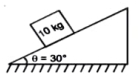
A block of mass $10 \,kg$ is kept on a fixed rough $(\mu=0.8)$ inclined plane of angle of inclination $30^{\circ}$. The frictional force acting on the block is ........... $N$
If the position vector of a particle is

$\vec r =  - \cos \,t\hat i + \sin \,t\hat j - 18\,t\hat k$

then what is the magnitude of its acceleration ?