The current in the primary circuit of a potentiometer is $0.2\, A$. The specific resistance and cross section of the potentiometer wire are $4\times10^{-7}\,ohm$ $metre$ and $8\times10^{-7}\, m^2$ respectively. The potential gradient will be equal to .............. $V/m$
AIEEE 2011, Medium


Download our appand get started for free
Experience the future of education. Simply download our apps or reach out to us for more information. Let's shape the future of learning together!No signup needed.*
Similar Questions
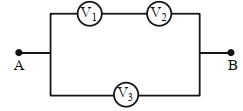
- 1Three voltmeters, all having different internal resistances are joined as shown in figure. When some potential difference is applied across $\mathrm{A}$ and $B$, their readings are $V_1, V_2$ and $V_3$. Choose the correct option.View Solution
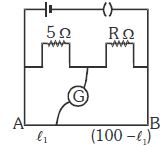
- 2The resistance in the two arms of a meter bridge are $5\,\Omega $ and $R\,\Omega $, respectively. When the resistance $R$ is shunted with an equal resistance, the new balance point is at $1.6\, l_1$. The resistance $‘R’$ is ................. $\Omega$View Solution
- 3The resistances of the platinum wire of a platinum resistance thermometer at the ice point and steam point are $8 \Omega$ and $10 \Omega$ respectively. After inserting in a hot bath of temperature $400^{\circ} \mathrm{C}$, the resistance of platinum wire is:View Solution
- 4For the given circuit, in the steady state, $\left| V _{ B }- V _{ D }\right|=.......V.$View Solution
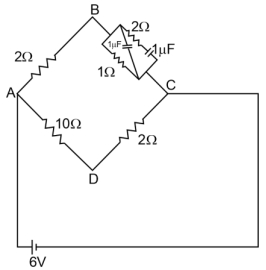
- 5In the circuit shown, if a conducting wire is connected between points $A$ and $B,$ the current in this wire willView Solution
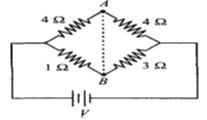
- 6The current between $B$ and $D$ in the given figure is .............. $amp$View Solution
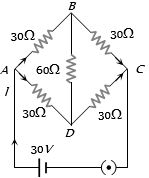
- 7In a Wheatstone’s bridge all the four arms have equal resistance $R$. If the resistance of the galvanometer arm is also $R$, the equivalent resistance of the combination as seen by the battery isView Solution
- 8The value of internal resistance of an ideal cell is $\Omega$View Solution
- 9A storage cell is charged by $5\, amp$ $D.C.$ for $18$ hours. Its strength after charging will be .............. $AH$View Solution
- 10An electron revolves $6 × 10^{15}$ times/sec in circular loop. The current in the loop isView Solution