MCQ
If $L , C$ and $R$ are the self inductance, capacitance and resistance respectively, which of the following does not have the dimension of time?
  • A
    $RC$
  • B
    $\frac{L}{R}$
  • C
    $\sqrt{ LC }$
  • $\frac{L}{C}$

Answer

Correct option: D.
$\frac{L}{C}$
d
$\left(\frac{L}{C}\right)$ does not have dimension of time.

$RC , \frac{ L }{ R }$ are time constant while $\sqrt{ LC }$ is reciprocal of angular frequency or having dimension of time.

Need a full question paper?

Generate a complete, print-ready paper with questions like this in minutes — across 16+ boards, with answer keys.
Start Generating Free

Similar questions

A cylindrical tube $(L = 120\,cm.)$ is resonant with a tuning fork of frequency $330\,Hz$. If it is filling by water then to get resonance minimum length of water column is ..... $cm$ $(V_{air} = 330\,m/s)$
A simple pendulum, suspended from the ceiling of a stationary van, has time period $T$. If the van starts moving with a uniform velocity the period of the pendulum will be
stationary source is emitting sound at a fixed frequency $f_0$, which is reflected by two cars approaching the source. The difference between the frequencies of sound reflected from the cars is $1.2\%$ of $f_0$. What is the difference in the speeds of the cars (in $km$ per hour) to the nearest integer ..... $km/hr$ ? The cars are moving at constant speeds much smaller than the speed of sound which is $330$ $ms^{-1}$.
Solid cylinders of radii ${r_1},\,{r_2}$ and ${r_3}$ roll down an inclined plane from the same place simultaneously. If ${r_1} > {r_2} > {r_3}$, which one would reach the bottom first
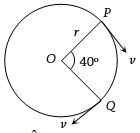
A particle is moving on a circular path of radius $r$ with uniform velocity $v$. The change in velocity when the particle moves from $P$ to $Q$ is $(\angle POQ = 40^\circ )$
$P,\,Q$ and $R$ are three balloons ascending with velocities $U,\,4U$ and $8U$ respectively. If stones of the same mass be dropped from each, when they are at the same height, then
The velocity of a particle moving on the $x-$ axis is given by $v = x^2 + x$ where $v$ is in $m/s$ and $x$ is in $m$ . Find its acceleration in $m/s^2$ when passing through the point $x = 2m$
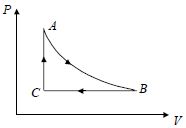
A fixed amount of a gas undergoes a thermodynamic process as shown such that heat interaction along path $B \to C \to A$ is equal to the work done by the gas along path $A \to B \to C$. Then process $A \to B$ is :-
A force of $6.4\, N$ stretches a vertical spring by $0.1 \,m$. The mass that must be suspended from the spring so that it oscillates with a period of $\left( {\frac{\pi }{4}} \right)sec$. is  ... $kg$
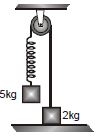
Pulley and spring are massless and the friction is absent everwhere. $5\, kg$ block is  released from rest. The speed of $5\, kg$ block when $2\, kg$ block leaves the contact  with ground is (take force constant of the spring $K = 40\, N/m$ and $g = 10\, m/s^2)$