MCQ
If $\left| {{{\vec v}_1} + {{\vec v}_2}} \right| = \left| {{{\vec v}_1} - {{\vec v}_2}} \right|$ and ${{{\vec v}_1}}$ and ${{{\vec v}_2}}$ are finite, then
  • A
    ${{{\vec v}_1}}$ is parallel to ${{{\vec v}_2}}$
  • B
    ${{{\vec v}_1} = {{\vec v}_2}}$
  • C
    $\left| {{{\vec v}_1}} \right| = \left| {{{\vec v}_2}} \right|$
  • ${{{\vec v}_1}}$ and ${{{\vec v}_2}}$ are mutually perpendicular
Answer

Correct option: D.
${{{\vec v}_1}}$ and ${{{\vec v}_2}}$ are mutually perpendicular
d

Need a full question paper?

Generate a complete, print-ready paper with questions like this in minutes — across 16+ boards, with answer keys.

Start Generating Free

Similar questions

A point object of mass $m$ is kept at $(a, 0)$ along $x$-axis. What mass should be kept at $(-3 a, 0)$, so that centre of mass lies at origin?
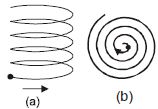
A particle is going with constant speed along a uniform helical and spiral path separately as shown in figure
According to $C.E.$ van der Waal, the interatomic potential varies with the average interatomic distance $(R)$ as
A pendulum is formed by pivoting a disc. What distance from center of mass, it should be pivoted for minimum time period while performing $SHM$ ?
A fly wheel is accelerated uniformly from rest and rotates through $5 \,rad$ in the first second. The angle rotated by the fly wheel in the next second, will be.........$rad$
A drop of mercury of radius $2\, mm$ is split into $8$ identical droplets. Find the increase in surface energy ....... $\mu J$. (Surface tension of mercury is $0.465\;J/{m^2}$)
A body executing simple harmonic motion has a maximum acceleration equal to $ 24\,metres/se{c^2} $ and maximum velocity equal to $ 16\;metres/sec $. The amplitude of the simple harmonic motion is
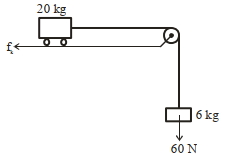
Consider a block and trolley system as shown in figure. If the coefficient of kinetic friction between the trolley and the surface is $0.04$ , the acceleration of the system in $\mathrm{ms}^{-2}$ is :

(Consider that the string is massless and unstretchable and the pulley is also massless and frictionless):

Which of the following states of matter has the maximum value of mean free path?
A hot air balloon with a payload rises in the air. Assume that the balloon is spherical in shape with diameter of $11.7 \,m$ and the mass of the balloon and the payload (without the hot air inside) is $210 \,kg$. Temperature and pressure of outside air are $27^{\circ} C$ and $1 atm =10^5 \,N / m ^2$, respectively. Molar mass of dry air is $30 \,g$. The temperature of the hot air inside is close to .......... $^{\circ} C$ [The gas constant, $R=8.31 \,JK ^{-1} mol ^{-1}$ ]