MCQ
If $n = 6,$ the correct sequence for filling of electrons will be
  • $ns \rightarrow (n - 2)f \rightarrow (n - 1)d \rightarrow np$
  • B
    $ns \rightarrow (n - 1)d \rightarrow (n - 2)f \rightarrow np$
  • C
    $ns \rightarrow (n - 2)f \rightarrow np \rightarrow (n - 1)d$
  • D
    $ns \rightarrow np(n - 1)d \rightarrow (n - 2)f$

Answer

Correct option: A.
$ns \rightarrow (n - 2)f \rightarrow (n - 1)d \rightarrow np$
a
$6 s \rightarrow 4 f \rightarrow 5 d \rightarrow 6 p\;\; f o r\; n=6$

Need a full question paper?

Generate a complete, print-ready paper with questions like this in minutes — across 16+ boards, with answer keys.

Start Generating Free

Similar questions

The difference between the reaction enthalpy change $\left( {{\Delta _r}H} \right)$ and reaction internal energy change $\left( {{\Delta _r}U} \right)$ for the reaction

$2C_6H_6 (l) + 15O_2 (g) \longrightarrow 12CO_2 (g) + 6H_2O(l)$

at $300\, K$ is ....$J\,mol^{-1}$ ($R = 8.314\, J\, mol^{-1}\, K^{-1}$)

What is the ratio of glyoxal to pyrualdehyde obtained in the above reaction ?

(figure) $\xrightarrow[{(2)\,Zn}]{{(1)\,{O_3}}}\mathop {\begin{array}{*{20}{c}}
  {\,\,\,\,O\,\,\,\,\,\,\,O\,\,} \\ 
  {\,||\,\,\,\,\,\,\,\,\,||} \\ 
  {H - C - C - H} 
\end{array}}\limits_{Glyoxal}  + $ $\mathop {\begin{array}{*{20}{c}}
  {\,\,\,O\,\,\,\,\,O\,\,} \\ 
  {\,||\,\,\,\,\,\,\,\,||} \\ 
  {C{H_3} - C - C - C{H_3}} 
\end{array}}\limits_{2,3 - Bu\tan edione}  + \mathop {\begin{array}{*{20}{c}}
  {\,\,\,\,\,\,O\,\,\,\,\,O} \\ 
  {\,\,\,\,\,\,||\,\,\,\,\,\,||} \\ 
  {C{H_3} - C - C - H} 
\end{array}}\limits_{Pyrualdehyde} $

What would happen to a reversible reaction at equilibrium when an inert gas is added while the pressure remains unchanged
Which type of overlapping results the formation of a $\pi $ bond
Which of following molecule has two unpaired $e^-$ with bond order equal to two
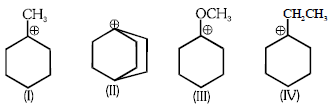
Arrange the following in correct order of stability
Based on the following thermochemical equations

${H_2}O\left( g \right) + C\left( s \right) \to CO\left( g \right) + {H_2}\left( g \right);\Delta H = 131\,kJ$

$CO\left( g \right) + \frac{1}{2}{O_2}\left( s \right) \to C{O_2}\left( g \right);\Delta H =  - 282\,kJ$

${H_2}\left( g \right) + \frac{1}{2}{O_2}\left( s \right) \to {H_2}O\left( g \right);\Delta H =  - 242\,kJ$

$C(s) + O_2(g) \to CO_2(g); \Delta H = X\,kJ$

The value of $X$ will be......$kJ$

The percentage of $p$-character in the orbitals forming $\mathrm{P}-\mathrm{P}$ bonds in $\mathrm{P}_4$ is
The hybridization of the central atom will change when
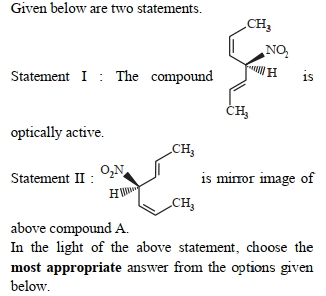
Given Below are Two statement