If one end of a wire is fixed with a rigid support and the other end is stretched by a force of $10 \,N,$ then the increase in length is $0.5\, mm$. The ratio of the energy of the wire and the work done in displacing it through $1.5\, mm$ by the weight is
Medium


Download our appand get started for free
Experience the future of education. Simply download our apps or reach out to us for more information. Let's shape the future of learning together!No signup needed.*
Similar Questions
- 1The area of cross section of a steel wire $(Y = 2.0 \times {10^{11}}N/{m^2})$ is $0.1\;c{m^2}$. The force required to double its length will beView Solution
- 2The relation between $\gamma ,\,\eta $ and $K$ for a elastic material isView Solution
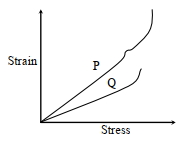
- 3In plotting stress versus strain curves for two materials $P$ and $Q$, a student by mistake puts strain on the $y$-axis and stress on the $x$-axis as shown in the figure. Then the correct statement$(s)$ is(are)View Solution
$(A)$ $P$ has more tensile strength than $Q$
$(B)$ $P$ is more ductile than $Q$
$(C)$ $P$ is more brittle than $Q$
$(D)$ The Young's modulus of $P$ is more than that of $Q$
- 4View SolutionWhen shearing force is applied on a body, then the elastic potential energy is stored in it. On removing the force, this energy
- 5Let a wire be suspended from the ceiling (rigid support) and stretched by a weight $W$ attached at its free end. The longitudinal stress at any point of cross-sectional area $A$ of the wire is :View Solution
- 6A steel wire of length $3.2 m \left( Y _{ S }=2.0 \times 10^{11}\,Nm ^{-2}\right)$ and a copper wire of length $4.4\,M$ $\left( Y _{ C }=1.1 \times 10^{11}\,Nm ^{-2}\right)$, both of radius $1.4\,mm$ are connected end to end. When stretched by a load, the net elongation is found to be $1.4\,mm$. The load applied, in Newton, will be. (Given $\pi=\frac{22}{7}$)View Solution
- 7A force of $200\, N$ is applied at one end of a wire of length $2\, m$ and having area of cross-section ${10^{ - 2}}\,c{m^2}$. The other end of the wire is rigidly fixed. If coefficient of linear expansion of the wire $\alpha = 8 \times 10{^{-6}}°C^{-1}$ and Young's modulus $Y = 2.2 \times {10^{11}}\,N/{m^2}$ and its temperature is increased by $5°C$, then the increase in the tension of the wire will be ........ $N$View Solution
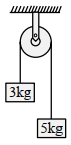
- 8Two blocks of masses $3 \,{kg}$ and $5\, {kg}$ are connected by a metal wire going over a smooth pulley. The breaking stress of the metal is $\frac{24}{\pi} \times 10^{2}\, {Nm}^{-2}$. What is the minimum radius of the wire? (Take $\left.g=10\, {ms}^{-2}\right)$ (in $cm$)View Solution
- 9$Assertion :$ Solids are least compressible and gases are most compressible.View Solution
$Reason :$ solids have definite shape and volume but gases do not have either definite shape or definite volume. - 10Two steel wires having same length are suspended from a ceiling under the same load. If the ratio of their energy stored per unit volume is $1: 4,$ the ratio of their diameters isView Solution