MCQ
If $P$ to $T$ are second period $p-$ block elements then which of the following graph show correct relation between valence electrons in $P_2$ to $T_2$ (corresponding molecules) and their bond order is
- ✓
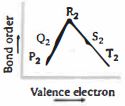
- B
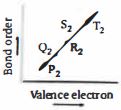
- C
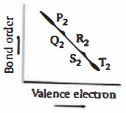
- D
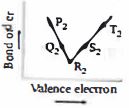
| Species : | $P_2: (B_2)$ | $Q_2:(C_2)$ | $R_2: (N_2)$ | $S_2(O_2)$ | $T_2 : (F_2)$ |
| Bond order | $1.0$ | $2.0$ | $3.0$ | $2.0$ | $1.0$ |
| Totnl No. of valence $e^-s$ | $6$ | $8$ | $10$ | $12$ | $14$ |
Generate a complete, print-ready paper with questions like this in minutes — across 16+ boards, with answer keys.
$\begin{array}{*{20}{c}}
{C{H_3} - CH - CH - C{H_3}\xleftarrow[{ether}]{{Na}}R\,' - Br\,\xrightarrow{{Mg}}'D'\,\xrightarrow{{{H_2}O}}E} \\
{\,\,\,\,|\,\,\,\,\,\,\,\,\,\,\,\,\,|\,\,\,\,\,\,\,\,\,\,\,\,\,\,\,\,\,\,\,\,\,\,\,\,\,\,\,\,\,\,\,\,\,\,\,\,\,\,\,\,\,\,\,\,\,\,\,\,\,\,\,\,\,\,\,\,\,\,\,\,\,\,\,\,\,\,\,\,\,\,\,\,\,\,\,\,\,\,\,\,\,\,\,\,\,\,\,} \\
{\,\,\,\,\,C{H_3}\,\,\,\,\,C{H_3}\,\,\,\,\,\,\,\,\,\,\,\,\,\,\,\,\,\,\,\,\,\,\,\,\,\,\,\,\,\,\,\,\,\,\,\,\,\,\,\,\,\,\,\,\,\,\,\,\,\,\,\,\,\,\,\,\,\,\,\,\,\,\,\,\,\,\,\,\,\,\,\,\,\,\,\,\,\,\,\,\,\,\,}
\end{array}$
| $Cl_2(g) \rightarrow 2Cl(g),$ | $242.3\,kJ\,mol^{-1}$ |
| $I_2(g) \rightarrow 2I(g),$ | $151.0\,kJ\,mol^{-1}$ |
| $ICl(g) \rightarrow I(g)+Cl(g),$ | $211.3\,kJ\,mol^{-1}$ |
| $I_2(s) \rightarrow I_2(g),$ | $62.76\,kJ\,mol^{-1}$ |
Given that the standard states for iodine and chlorine are $I_2(s)$ and $Cl_2(g),$ the standard enthalpy of formation for $ICl(g)$ is : ............... $\mathrm{kJ\,mol}^{-1}$