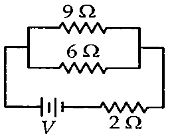
If power dissipated in the $9 \,\Omega$ resistor in the circuit shown is $36\,W$, the potential difference across the $2 \,\Omega$ resistor is .......... $V$
AIPMT 2011, Medium
Download our app for free and get started
Current flows through the $9\, \Omega$ resistor is
${I_{1}^{2}=\frac{36}{9}=4} $ $\left( {As\,\,P = {I^2}R} \right)$
${I_{1}=2 \,\mathrm{A}}$
As the resistors $9\, \Omega$ and $6\, \Omega$ are connected in parallel, therefore potential difference across them is
same.
$\therefore \quad 9 I_{1}=6 I_{2} ; I_{2}=\frac{9 \times 2}{6}=3\, \mathrm{A}$
Current drawn from the battery is
$I=I_{1}+I_{2}=(2+3) \mathrm{A}=5\, \mathrm{A}$
The potential difference across the $2\, \Omega$ resistor is
$=(5 \,A)(2 \,\Omega)=10\, \mathrm{V}$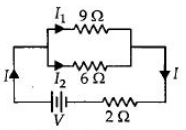

Download our appand get started for free
Experience the future of education. Simply download our apps or reach out to us for more information. Let's shape the future of learning together!No signup needed.*
Similar Questions
- 1A heating element has a resistance of $100\,\Omega $ at room temperature. When it is connected to a supply of $220\,V,$ a steady current of $2\,A$ passes in it and temperature is $500\,^oC$ more than room temperature. What is the temperature coefficient resistance of the heating element?View Solution
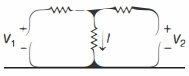
- 2Two batteries $V_1$ and $V_2$ are connected to three resistors as shown below. If $V_1=2 \,V$ and $V_2=0 \,V$, then the current $I=3 \,mA$. If $V_1=0 \,V$ and $V_2=4 \,V$, then the current $I=4 \,mA$. Now, if $V_1=10 \,V$ and $V_2=10 \,V$, then the current $I$ will be ............ $\,mA$View Solution
- 3By what percentage will the illumination of the lamp decrease if the current drops by $20 \%$ ?View Solution
- 4There are two wires of the same length and of the same material and radii $r$ and $2r$ . The ratio of their specific resistance isView Solution
- 5$A$. The drift velocity of electrons decreases with the increase in the temperature of conductor.View Solution
$B$. The drift velocity is inversely proportional to the area of cross-section of given conductor.
$C$. The drift velocity does not depend on the applied potential difference to the conductor.
$D$. The drift velocity of electron is inversely proportional to the length of the conductor.
$E$. The drift velocity increases with the increase in the temperature of conductor.
Choose the correct answer from the options given below:
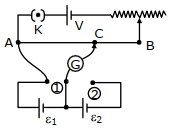
- 6In the given potentiometer circuit arrangement, the balancing length ${AC}$ is measured to be $250$ ${cm}$. When the galvanometer connection is shifted from point $(1)$ to point $(2)$ in the given diagram, the balancing length becomes $400\, {cm}$. The ratio of the emf of two cells, $\frac{\varepsilon_{1}}{\varepsilon_{2}}$ is -View Solution
- 7In the circuit shown in the adjoining figure, the current between $B$ and $D$ is zero, the unknown resistance is of ................ $\Omega$View Solution
- 8In given figure, the potentiometer wire $AB$ has a resistance of $5$ $\Omega$ and length $10\, m$. The balancing length $AM$ for the $emf$ of $0.4\, V$ is ............... $m$View Solution
- 9View SolutionOhm's law fails in
- 10For a metallic wire, the ratio $V/i$ ($V = $ the applied potential difference, $i$ = current flowing) isView Solution