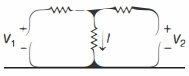
Two batteries $V_1$ and $V_2$ are connected to three resistors as shown below. If $V_1=2 \,V$ and $V_2=0 \,V$, then the current $I=3 \,mA$. If $V_1=0 \,V$ and $V_2=4 \,V$, then the current $I=4 \,mA$. Now, if $V_1=10 \,V$ and $V_2=10 \,V$, then the current $I$ will be ............ $\,mA$
KVPY 2011, Advanced
Download our app for free and get started
(d)
Given circuit is a parallel combination of two cells connected across a resistance $R$.
Now, for parallel combination of cells
$V_{ eq }=\frac{\frac{V_1+V_2}{R_1}}{\frac{1}{R_1}+\frac{1}{R_2}}$
$\Rightarrow \quad V_{ eq }=\frac{V_1 R_2+V_2 R_1}{R_1+R_2} \quad \dots(i)$
$\text { and } R_{ eq }=\frac{R_1 R_2}{R_1+R_2} \quad \dots(ii)$
So, current through resistance $R$ is
$I=\frac{V_{\text {eq }}}{R+R_{\text {eq }}} \quad \dots(iii)$
In case $A$
$V_1=2 V , V_2=0 V \text { and } I=3 \,mA$
So, from Eqs. $(i), (ii)$ and $(iii)$, we get
$V_{\text {eq }}=\frac{2 \cdot R_2+0 \cdot R_1}{R_1+R_2}=\frac{2 R_2}{R_1+R_2}$
$R_{\text {eq }}=\frac{R_1 R_2}{R_1+R_2} \text { and } I=\frac{2 R_2 / R_1+R_2}{R+\frac{R_1 R_2}{R_1+R_2}}$
$\Rightarrow \quad 3 mA =\frac{2 R_2}{R\left(R_1+R_2\right)+R_1 R_2}$
In case $B$
$V_1=0 \,V , V_2=4 \,V \text { and } I=4 \,mA$
$\Rightarrow \quad 4 \,mA =\frac{4 R_1}{R\left(R_1+\overline{R_2}\right)+R_1 R_2} \quad \dots(v)$
From Eqs. $(iv)$ and $(v)$, we have
$\frac{3}{4}=\frac{2 R_2}{4 R_1} \Rightarrow \frac{3}{4}=\frac{R_2}{2 R_1} \Rightarrow \frac{R_2}{R_1}=\frac{3}{2}$
In case $C$
$V_1=10 \,V$ and $V_2=10 \,V$
So, if current through resistance $R$ is $I$, then
$V_{e q}=\frac{10 R_1+10 R_2}{R_1+R_2}$
and so $I=\frac{10 R_1+10 R_2}{R\left(R_1+R_2\right)+R_1 R_2} \quad \dots(vi)$
Now, from Eqs. $(iv)$ and $(vi)$, we have
$\frac{3}{I}=\frac{\left(\frac{2 R_2}{R\left(R_1+R_2\right)+R_1 R_2}\right)}{\left(\frac{10 R_1+10 R_2}{R\left(R_1+R_2\right)+R_1 R_2}\right)}$
$\Rightarrow \quad \frac{3}{I}=\frac{2 R_2}{10 R_1+10 R_2}$
$\Rightarrow \quad \frac{I}{3}=5 \frac{R_1}{R_2}+5$
$\Rightarrow \quad \frac{I}{3}=5\left(\frac{2}{3}\right)+5$
$\Rightarrow \quad I=10+15=25 \,mA$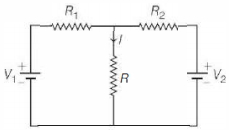

Download our appand get started for free
Experience the future of education. Simply download our apps or reach out to us for more information. Let's shape the future of learning together!No signup needed.*
Similar Questions
- 1In Wheatstone's bridge $P = 9\, ohm$, $Q = 11\, ohm$, $R = 4\,ohm$ and $S = 6\,ohm$. How much resistance must be put in parallel to the resistance $S$ to balance the bridge ............... $ohm$View Solution
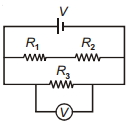
- 2In the circuit shown, $R_1$ is increased. What happens to the reading of the voltmeter (ideal)?View Solution
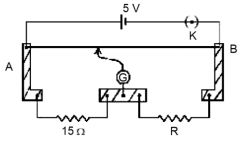
- 3A meter bridge setup is shown in the figure. It is used to determine an unknown resistance $R$ using a given resistor of $15\,\Omega$. The galvanometer $(G)$ shows null deflection when tapping key is at $43\,cm$ mark from end $A$. If the end correction for end $A$ is $2\,cm$. then the determined value of $R$ will be__________ $\Omega$View Solution
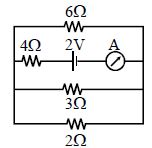
- 4The reading of the ammeter in the adjoining figure will be .............. $A$View Solution
- 5A carbon resistor has colour strips as violet, yellow brown and golden. The resistance is .............. $\Omega$View Solution
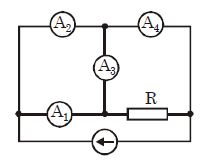
- 6Four ammeters with identical internal resistances $r$ and a resistor of resistance $R$ are connected to a current source as shown in figure. It is known that the reading of the ammeter $A_1$ is $I_1 = 3\ A$ and the reading of the ammeter $A_2$ is $I_2 = 5\ A$ . Determine the ratio of the resistances $R/r$ .View Solution
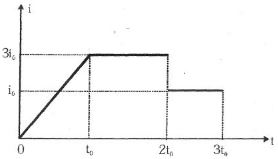
- 7A time varying current $i$ is passed through a resistance $R$ as shown in figure. The total heat generated in the resistance isView Solution
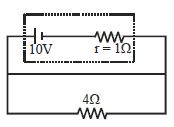
- 8Potential difference across the terminals of the battery shown in figure is .................... $V$ ($r =$ internal resistance of battery)View Solution
- 9The resistance of a wire is $R\; ohm$. If it is melted and stretched to $'n'$ times its original length, its new resistance will beView Solution
- 10If the resistance of a conductor is $5\,\Omega\,\,$ at $\,50\,^oC$ and $7\, \Omega\,$ at $\,100\,^oC$ then the mean temperature coefficient of resistance of the material is ............... $^oC$View Solution