If $q$ is the charge per unit area on the surface of a conductor, then the electric field intensity at a point on the surface is
Easy


Download our appand get started for free
Experience the future of education. Simply download our apps or reach out to us for more information. Let's shape the future of learning together!No signup needed.*
Similar Questions
- 1The distance between the plates of a parallel plate condenser is $8\,mm$ and $P.D.$ $120\;volts$. If a $6\,mm$ thick slab of dielectric constant $6$ is introduced between its plates, thenView Solution
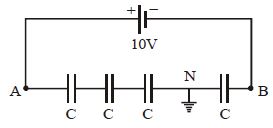
- 2Four identical capacitors are connected in series with a $10\,V$ battery as shown. The point $N$ is earthed. The potentials of points $A$ and $B$ areView Solution
- 3In a certain charge distribution, all points having zero potential can be joined by a circle $S$. Points inside $S$ have positive potential and points outside $S$ have negative potential. A positive charge, which is free to move, is placed inside $S$View Solution
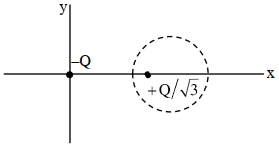
- 4Two point charges $-Q$ and $+Q / \sqrt{3}$ are placed in the xy-plane at the origin $(0,0)$ and a point $(2,0)$, respectively, as shown in the figure. This results in an equipotential circle of radius $R$ and potential $V =0$ in the $xy$-plane with its center at $(b, 0)$. All lengths are measured in meters.View Solution
($1$) The value of $R$ is. . . . meter.
($2$) The value of $b$ is. . . . . .meter.
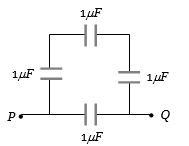
- 5Four capacitors are connected as shown in the equivalent capacitance between the points $P$ and $Q$ is.......$\mu F$View Solution
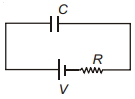
- 6As in the figure, if a capacitor of capacitance $C$ is charged by connecting it with resistance $R$, then energy given by the battery will beView Solution
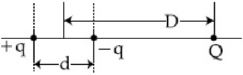
- 7A system of three charges are placed as shown in the figure.View Solution
If $D > > d,$ the potential energy of the system is best given $b$
- 8View SolutionThe energy of a charged capacitor resides in
- 9A hollow metal sphere of radius $5\, cm$ is charged so that the potential on its surface is $10\, V$. The potential at the centre of the sphere isView Solution
- 10For changing the capacitance of a given parallel plate capacitor, a dielectric material of dielectric constant $K$ is used, which has the same area as the plates of the capacitor. The thickness of the dielectric slab is $\frac{3}{4} d$, where $'d'$ is the separation between the plates of parallel plate capacitor. The new capacitance $(C')$ in terms of original capacitance $\left( C _{0}\right)$ is given by the following relationView Solution