MCQ
If $t =\sqrt{ x }+4$, then $\left(\frac{ dx }{ dt }\right)_{ t =4}$ is.
  • A
    $4$
  • $0$
  • C
    $8$
  • D
    $16$

Answer

Correct option: B.
$0$
b
$t =\sqrt{ x }+4$

$\Rightarrow x =( t -4)^{2}= t ^{2}-8 t +16$

$\Rightarrow \frac{ dx }{ dt }=2 t -8$

$\left.\Rightarrow \frac{ dx }{ dt }\right|_{ t =4}=2 \times 4-8=0$

Need a full question paper?

Generate a complete, print-ready paper with questions like this in minutes — across 16+ boards, with answer keys.
Start Generating Free

Similar questions

Electric charges $q,\,q,\, - 2q$ are placed at the corners of an equilateral triangle $ABC$ of side $l$. The magnitude of electric dipole moment of the system is
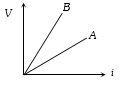
$V-i$ graphs for parallel and series combination of two identical resistors are as shown in figure. Which graph represents parallel combination
A perfect gas contained in a cylinder is kept in vacuum. If the cylinder suddenly bursts, then the temperature of the gas
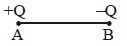
Two point charges of same magnitude and opposite sign are fixed at points $A$ and $B$. $A$ third small point charge is to be balanced at point $P$ by the electrostatic force due  to these two charges. The point $P$
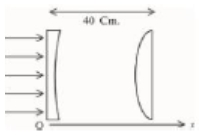
As shown in the figure, a combination of a thin plano concave lens and a thin plano convex lens is used to image an object placed at infinity. The radius of curvature of both the lenses is $30\,cm$ and refraction index of the material for both the lenses is $1.75$. Both the lenses are placed at distance of $40\,cm$ from each other. Due to the combination, the image of the object is formed at distance $x =..........cm$, from concave lens.
The current in a conductor is expressed as $I=3 t^2+4 t^3$, where $I$ is in Ampere and $t$ is in second. The amount of electric charge that flows through a section of the conductor during $t=1$ s to $t=2 \mathrm{~s}$ is_______ C.
According to Bohr's theory the moment of momentum of an electron revolving in second orbit of hydrogen atom will be
The electrostatic force of interaction between an uniformly charged rod having total charge $Q$ and length $L$ and a point charge $q$ as shown in figure is
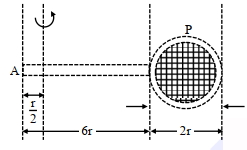
Consider a badminton racket with length scales as shown in the figure.If the mass of the linear and circular portions of the badminton racket are same $(M)$ and the mass of the threads are negligible, the moment of inertia of the racket about an axis perpendicular to the handle and in the plane of the ring at, $\frac{r}{2}$ distance from the end $A$ of the handle will be ....... $Mr^2$?
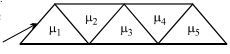
The diagram shows five isosceles right angled prisms.Alight ray incident at $90^o$ at the first face emerges at same angle with the normal from the last face. Which of the following relations will hold regarding the refractive indices?