Question
The electrostatic force of interaction between an uniformly charged rod having total charge $Q$ and length $L$ and a point charge $q$ as shown in figure is

$\Rightarrow \mathrm{F}=\frac{1}{4 \mathrm{n} \in_{0}} \frac{\mathrm{qQ}}{\mathrm{L}}\left|\frac{1}{-\mathrm{x}}\right|_{\mathrm{d}}^{\mathrm{d}+\mathrm{L}}$
$F = \frac{1}{{4\pi { \in _0}}}\frac{{Qq}}{L}\left[ { - \frac{1}{{d + L}} + \frac{1}{d}} \right]$
$ = \frac{1}{{4\pi { \in _0}}}\frac{{qQ}}{L}\left[ {\frac{{ - d + d + L}}{{d(d + L)}}} \right]$
${\rm{F}} = \frac{1}{{4\pi { \in _0}}}\frac{{{\rm{qQ}}}}{{{\rm{d}}({\rm{d}} + {\rm{L}})}}$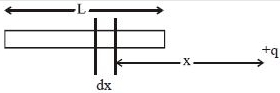
Generate a complete, print-ready paper with questions like this in minutes — across 16+ boards, with answer keys.
$(i)$ The average kinetic energy of each molecule of $H_2$ and $Ar$ are the same.
$(ii)$ The partial pressure due to argon gas is more than that due to hydrogen gas