Question
If $\tan\theta=\frac{\text{a}}{\text{b}},$ show that $\frac{(\text{a}\sin\theta-\text{b}\cos\theta)}{(\text{a}\sin\theta+\text{b}\cos\theta)}=\frac{\big(\text{a}^2-\text{b}^2\big)}{\big(\text{a}^2 +\text{b}^2\big)}.$
Answer

Given:
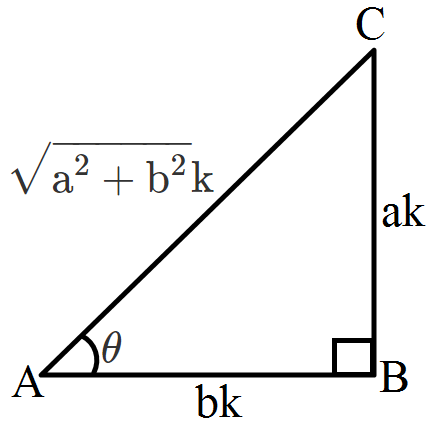
$\tan\theta=\frac{\text{a}}{\text{b}}=\frac{\text{ak}}{\text{bk}}=\frac{\text{BC}}{\text{AB}}$
Let us draw a $\triangle\text{ABC}$ in which $\angle\text{B}=90^\circ$ and $\angle\text{A}=\theta$

By pythagoras theoram, we have
$\text{AC}^2=\text{AB}^2+\text{BC}^2=\text{b}^2\text{k}^2+\text{a}^2\text{k}^2$
$\therefore\text{AC}=\sqrt{\text{a}^2+\text{b}^2}\text{k}$
$\sin\theta=\frac{\text{BC}}{\text{AC}}=\frac{\text{ak}}{\sqrt{\text{a}^2+\text{b}^2}\text{k}}=\frac{\text{a}}{\sqrt{\text{a}^2+\text{b}^2}}$
$\cos\theta=\frac{\text{AB}}{\text{AC}}=\frac{\text{bk}}{\sqrt{\text{a}^2+\text{b}^2}\text{k}}=\frac{\text{b}}{\sqrt{\text{a}^2+\text{b}^2}}$
$\text{L.H.S.}=\frac{\text{a}\sin\theta-\text{b}\cos\theta}{\text{a}\sin\theta+\text{b}\cos\theta}$
$=\frac{\text{a}\frac{\text{a}}{\sqrt{\text{a}^2+\text{b}^2}}-\text{b}.\frac{\text{b}}{\sqrt{\text{a}^2+\text{b}^2}}}{\text{a}\frac{\text{a}}{\sqrt{\text{a}^2+\text{b}^2}}+\text{b}.\frac{\text{b}}{\sqrt{\text{a}^2+\text{b}^2}}}=\frac{\frac{\text{a}^2-\text{b}^2}{\sqrt{\text{a}^2+\text{b}^2}}}{\frac{\text{a}^2+\text{b}^2}{\sqrt{\text{a}^2+\text{b}^2}}}=\frac{\text{a}^2-\text{b}^2}{\text{a}^2+\text{b}^2}$
$=\text{R.H.S.}$

Need a full question paper?

Generate a complete, print-ready paper with questions like this in minutes — across 16+ boards, with answer keys.
Start Generating Free

Similar questions

Draw a circle of radius 3cm. From a point P, 7cm away from the centre of the circle, draw two tangents to the circle. Also, measure the lengths of the tangents.
Solve the following systems of equations by using the method of cross multiplication:
$3x + 2y + 25 = 0,$
$2x + y + 10 = 0$
If 2 is added to each of two given numbers, their ratio becomes 1 : 2. However, if 4 is subtracted from each of the given numbers, the ratio becomes 5 : 11. Find the numbers.
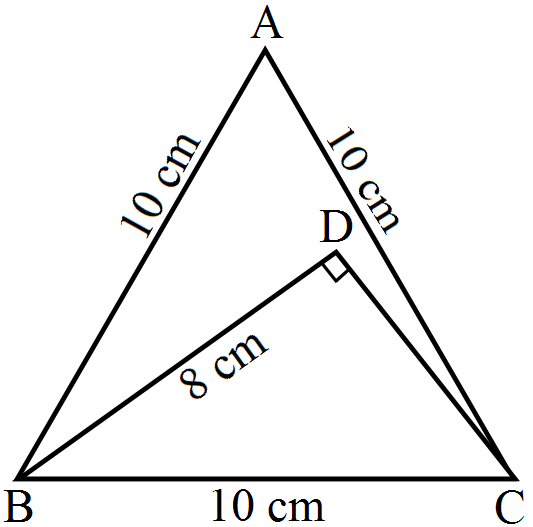
In the given figure, $\triangle\text{ABC}$ is an equilateral triangle the length of whose side is equal to $10\ cm,$ and $\triangle\text{DBC}$ is right-angled at $D$ and $BD = 8\ cm.$ Find the area of the shaded region. $\big[\text{Take}\sqrt{3}=1.41\big]$
Solve each of the following given systems of equations graphically and find the vertices and area of the triangle formed by these lines and the y-axis:
2x - 3y + 6 = 0, 2x + 3y - 18 = 0
In a right $\triangle\text{ABC},$ right-angled at B, if $\tan\text{A}=1$ then verify that $2\sin\text{A}\cdot\cos\text{A}=1.$
Find the distance between of the following points from the origin:
C(-4, -6)
The angle of elevation of the top Q of a vertical tower PQ from a point X on the ground is 60°. At a point Y, 40m vertically above X, the angle of elevation is 45°. Find the height of tower. $\big[\text{Take}\sqrt{3}=1.732\big]$
Draw a circle with centre O and radius 4cm. Draw any diameter AB of this circle. Construct tangents to the circle at each of the two end points of the diameter AB.
Show that $\big(4+3\sqrt2\big)$ is irrational.