Question
If $\text{a}=\sqrt2+1,$ then write the value of $\text{a}-\frac{1}{\text{a}}.$

Answer

Given that $\text{a}=\sqrt2+1,$
Hence $\frac{1}{\text{a}}$ is
given as $\frac{1}{\text{a}}=\frac{1}{\sqrt2+1}.$
we are asked to find $\text{a}-\frac{1}{\text{a}}$
We know that rationalization factor for $\sqrt2+1$ is $\sqrt2-1.$
We will multiply each side of the given expression $\frac{1}{\sqrt2+1}$ by $\sqrt2-1,$ to get $\frac{1}{\text{a}}=\frac{1}{\sqrt2-1}\times\frac{\sqrt2-1}{\sqrt2-1}$
$=\frac{\sqrt2-1}{\big(\sqrt2\big)^2-(1)^2}$
$=\frac{\sqrt2-1}{\sqrt2-1}$
$=\sqrt2-1$ Therefore, $\text{a}-\frac{1}{\text{a}}=\sqrt2+1-\big(\sqrt2-1\big)$
$=\sqrt2+1-\sqrt2+1$
$=2$ Hence the value of the given expresion is $2.$

Need a full question paper?

Generate a complete, print-ready paper with questions like this in minutes — across 16+ boards, with answer keys.

Start Generating Free

Similar questions

The production of saleable steel in some of the steel plants of our country during $1999$ is given below:
Plant
Bhilai
Durgapur
Rourkela
Bokaro
Production (in thousands)
$160$
$80$
$200$
$150$
Construct a bar graph to represent the above data on a graph paper by using the scale $1$ big divisions $= 20$ thousand tones.
Using factor theorem, factorize the following polynomials: $2y^3 + y^2 - 2y - 1$
Prove that angle bisector of any angle of a triangle and perpendicular bisector of the opposite side if intersect, they will intersect on the circumcircle of the triangle.
Draw the graph of the equations given below. Also, find the coordinates of the points where the graph cuts the coordinate axes: $3x + 2y + 6 = 0$
$BD$ and $CE$ are bisectors of $\angle\text{B}$ and $\angle\text{C}$ of an isosceles $\triangle\text{ABC}$ with $\text{AB}=\text{AC}.$ Prove that $\text{BD}=\text{CE}.$
Find five rational numbers between $1$ and $2.$
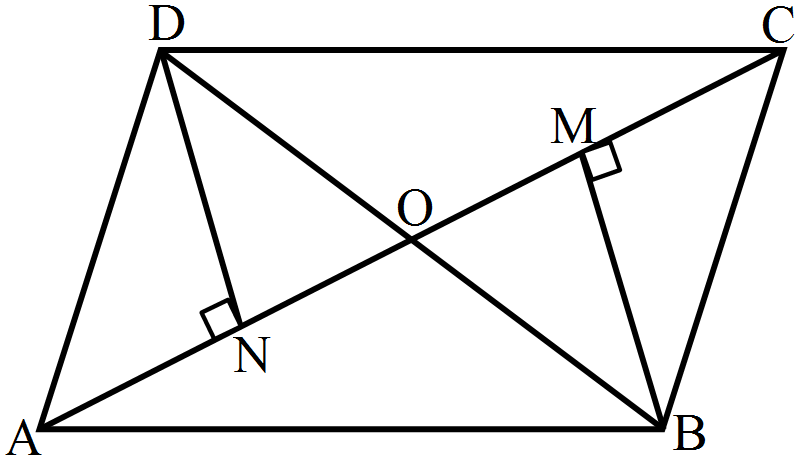
In the adjoining figure, $\text{BM}\perp\text{AC}$ and $\text{DN}\perp\text{AC}.$ If $BM = DN$, prove that $AC$ bisects $BD$.
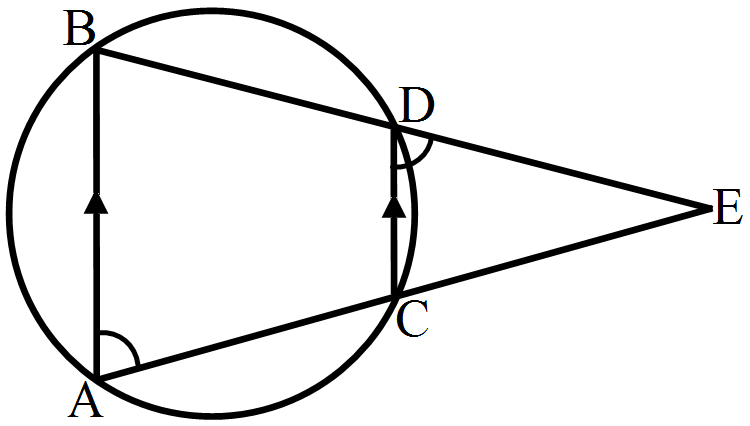
In the given figure, $AB$ and $CD$ are two parallel chords of a circle. If $BDE$ and $ACE$ are straight lines, intersecting at $E$, prove that $\triangle\text{AEB}$ is isosceles.
$O$ is a point in the interior of a square $ABCD$ such that $OAB$ is an equilateral triangle. Show that $ΔOCD$ is an isosceles triangle.
In a $\triangle ABC$, if $L$ and $M$ are points on $AB$ and $AC$ respectively such that $LM \| BC$. Prove that:
$i. \text{ar}(\triangle\text{LCM})=\text{ar}(\triangle\text{LBM})$
$ii. \text{ar}(\triangle\text{LBC})=\text{ar}(\triangle\text{MBC})$
$iii. \text{ar}(\triangle\text{ABM})=\text{ar}(\triangle\text{ACL})$
$iv. \text{ar}(\triangle\text{LOB})=\text{ar}(\triangle\text{MOC})$