Question
If $\text{y}=\Big[\log\Big(\text{x}+\sqrt{\text{x}^2+1}\Big)\Big]^2$ show that $(1+\text{x}^2)\frac{\text{d}^2\text{y}}{\text{dx}^2}+\text{x}\frac{\text{dy}}{\text{dx}}=2$

Answer

Given:
$\text{y}=\Big[\log\Big(\text{x}+\sqrt{1+\text{x}}\Big)\Big]^2$
Differentiating w.r.t. x,
$\frac{\text{dy}}{\text{dx}}=\frac{\text{d}\big[\log\big(\text{x}+\sqrt{1+\text{x}^2}\big)\big]^2}{\text{dx}}$
Using formula (ii),
$\Rightarrow\frac{\text{dy}}{\text{dx}}=2\log\big(\text{x}+\sqrt{1+\text{x}}\big).\frac{1}{(\text{x}+\sqrt{1+\text{x}^2})}.\Big(1+\frac{2\text{x}}{2\sqrt{1+\text{x}^2}}\Big)$
Using formula (i),
$\Rightarrow\text{y}_1=\frac{2\log(\text{x}+\sqrt{1+\text{x}^2}}{\text{x}+\sqrt{1+\text{x}^2}}.\frac{\text{x}+\sqrt{1+\text{x}^2}}{\sqrt{1+\text{x}^2}}$
$\Rightarrow\text{y}_1=\frac{2\log(\text{x}\sqrt{1+\text{x}^2})}{\sqrt{1+\text{x}^2}}$
Squaring both sides:
$\text{(y}_1)^2=\frac{4}{1+\text{x}^2}[\log\big(\text{x}\sqrt{1+\text{x}^2}\big)$
Differentiating w.r.t. x,
$\Rightarrow(1+\text{x}^2)\text{y}_2\text{y}_1+2\text{x}(\text{y}_1)^2=4\text{y}_1$
Using formual (iii),
$\Rightarrow(1+\text{x}^2)\text{y}_2+\text{xy}_1=2$
Hence proved.

Need a full question paper?

Generate a complete, print-ready paper with questions like this in minutes — across 16+ boards, with answer keys.
Start Generating Free

Similar questions

Evaluate the following definite integrals:
$\int_{0}^\limits{\infty}\frac{1}{\text{a}^2+\text{b}^2\text{x}^2} \text{ dx}$
If the coordinates of the points $A, B, C,$ are $(1, 2, 3), (4, 5, 6), (-4, 3, -6)$ and $(2, 9, 2)$, then find the angle between $AB$ and $CD.$
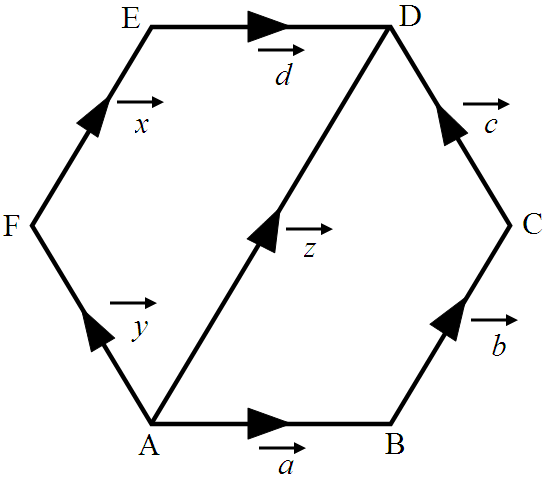
In Figure ABCD is a regular hexagon, which vectors are:
  1. Collinear.
  2. Equal.
  3. Co-initial.
  4. Collinear but not equal.
Find the area of the region $\{(\text{x},\text{y}):\text{x}^2+\text{y}^2\leq4,\text{x}+\text{y}\geq2\}$
Evaluate the following integrals as limit of sum:
$\int\limits^{3}_{1}\big(2\text{x}^2+5\text{x}\big)\text{dx}$
$\text{If A}= \begin{pmatrix} 2 & 3 & 10 \\ 4& -6 & 5 \\ 6& 9& -20 \end{pmatrix},\text{ find A}^{-1}.\text{ Using A}^{-1}\text{ Solve the system of equation }$
$\frac{2}{\text{x}}+\frac{3}{\text{y}}+\frac{10}{\text{z}}=2;\frac{4}{\text{x}}-\frac{6}{\text{y}}+\frac{5}{\text{z}}=5;\frac{6}{x}+\frac{9}{\text{y}}-\frac{20}{\text{z}}=-4$
Evaluate the following intregals:
$\int\frac{\text{ax}^2+\text{bx}+\text{c}}{(\text{x}-\text{a})(\text{x}-\text{b})(\text{x}-\text{c})}\ \text{dx},$ where a, b, c are distinct
Determine whether the following pair of lines intersect or not:
$\frac{\text{x}-5}{4}=\frac{\text{y}-7}{4}=\frac{\text{z}+3}{-5}$ and $\frac{\text{x}-8}{7}=\frac{\text{y}-4}{1}=\frac{3-5}{3}$
Solve the system of linear equation, using matrix method 2x + 3y + 3z = 5; x - 2y + z = - 4; 3x - y - 2z = 3
Find the area of the region bounded by the curve $y = x - 1$ and $(y - 1)^2 = 4(x + 1).$