MCQ
If the current is doubled, the deflection is also doubled in:
  • A
    A tangent galvanometer.
  • A moving$-$coil galvanometer.
  • C
    Both.
  • D
    None.

Answer

Correct option: B.
A moving$-$coil galvanometer.

The current and deflection dependence of a moving coil galvanometer is given by
$\text{i}=\frac{\text{k}}{\text{nAB}}\theta\Rightarrow\text{i}\propto\theta$
Therefore, if we double the current, the deflection also gets doubled.
However, in a tangent galvanometer, $\text{i}\propto\tan\theta$; that is, there is no direct relation between $\theta$ and current.
Hence, the correct option is $(b).$

Need a full question paper?

Generate a complete, print-ready paper with questions like this in minutes — across 16+ boards, with answer keys.
Start Generating Free

Similar questions

The light waves from two coherent sources have same intensity ${I}_{1}={I}_{2}={I}_{0} .$ In interference pattern the intensity of light at minima is zero.What will be the intensity of light at maxima?
A conductor in the form of a right angle $ABC$ with $AB = 3\, cm$ and $BC = 4\, cm$ carries a current of $10\, A$. There is a uniform magnetic field of $5\, T$ perpendicular to the plane of the conductor. The force on the conductor will be......$N$
A $50 Hz, 20 V AC$ source is connected across $R$ series circuit as shown in Figure If the voltage across $R$ is $12V$ then voltage across capacitor is.
Image
In an inductor of self-inductance $L = 2\,mH,$ current changes with time according to relation $i = t^2e^{-t}$. At what time $emf$ is zero?.....$s$
The potential at a point $x$ (measured in $μ\ m$) due to some charges situated on the $ x$-axis is given by $V(x)$ =$\frac{{20}}{{{x^2} - 4}}$ $volt$ The electric field $E$ at $x = 4\ μ m$ is given by
If in the experiment of Wheatstone’s bridge, the positions of cells and galvanometer are interchanged, then balance point will:
What is the atomic mass $(u)$ of calcium?
In a moving coil galvanometer, the deflection of the coil $\theta $ is related to the electrical current $i$ by the relation
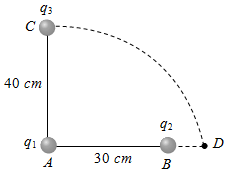
To charges $q_1$ and $q_2$ are placed 30 cm apart, shown in the figure. A third charge $q_3$ is moved along the arc of a circle of radius 40 cm from C to D. The change in the potential energy of the system is $\frac{\mathrm{q}_{\mathrm{g}}}{4 \pi \varepsilon_0} \mathrm{k}$, where k is
The output of given logic circuit is