If the distance between parallel plates of a capacitor is halved and dielectric constant is doubled then the capacitance will become
Easy
Download our app for free and get started
$C=\frac{\varepsilon_{0} \varepsilon_{\mathrm{r}} A}{d}$
$C^{\prime}=\frac{\varepsilon_{0} \times 2 \varepsilon_{\mathrm{r}} \mathrm{A}}{\frac{\mathrm{d}}{2}}=4 \times \frac{\varepsilon_{0} \varepsilon_{\mathrm{r}} \mathrm{A}}{\mathrm{d}}=4 \mathrm{\,C}$

Download our appand get started for free
Experience the future of education. Simply download our apps or reach out to us for more information. Let's shape the future of learning together!No signup needed.*
Similar Questions
- 1View SolutionThe capacitance of a parallel plate condenser does not depend on
- 2If $E$ is the electric field intensity of an electrostatic field, then the electrostatic energy density is proportional toView Solution
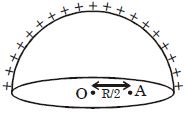
- 3A hemispherical bowl of mass $m$ is uniformly charged with charge density $'\sigma '$ . Electric potential due to charge distribution at a point $'A'$ is (which lies at centre of radius as shown).View Solution
- 4A parallel plate capacitor has capacitance $C$ . If charges of the plates are $Q$ and $-3Q$ , find the potential difference between the platesView Solution
- 5A charge of $40\,\mu \,C$ is given to a capacitor having capacitance $C = 10\,\mu \,F$. The stored energy in ergs isView Solution
- 6A negatively charged plate has charge density of $2 \times {10^{ - 6}}\,C/{m^2}$. The initial distance of an electron which is moving toward plate, cannot strike the plate, if it is having energy of $200\,eV$View Solution
- 7The electric potential $V(x)$ in a region around the origin is given by $V(x) = 4x^2\,volts$ . The electric charge enclosed in a cube of $1\,m$ side with its centre at the origin is (in coulomb)View Solution
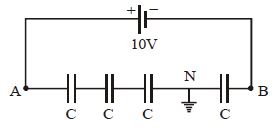
- 8Four identical capacitors are connected in series with a $10\,V$ battery as shown. The point $N$ is earthed. The potentials of points $A$ and $B$ areView Solution
- 9A capacitor of capacitance $C$ is charged to a potential difference $V_0$. The charging battery is removed and the capacitor is now connected to an uncharged capacitor of unknown capacity, the potential difference across the combination becomes $V$. The unknown capacitance isView Solution
- 10The capacity of a condenser is $4 \times {10^{ - 6}}$ farad and its potential is $100\,\,volts$. The energy released on discharging it fully will be.......$Joule$View Solution