MCQ
If the distance covered by an object is directly proportional to time, then we can say that the object :
  • A
    moves with zero velocity
  • B
    moving at a constant speed
  • C
    acceleration is constant
  • has the same velocity

Answer

Correct option: D.
has the same velocity
d

Need a full question paper?

Generate a complete, print-ready paper with questions like this in minutes — across 16+ boards, with answer keys.
Start Generating Free

Similar questions

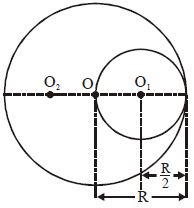
A spherical hollow is made in a lead sphere of radius $R,$ such that its surface touches the outside surface of lead sphere and passes through the centre. What is the shift in the centre of mass of lead sphere due to the following ?
A rod of length $l$ and area of cross-section $A$ is heated from $0°C$ to $100°C$. The rod is so placed that it is not allowed to increase in length, then the force developed is proportional to
Two water pipes of diameters $ 2 cm $ and $4 cm $ are connected with the main supply line. The velocity of flow of water in the pipe of $ 2 cm$  diameter is
If a satellite of mass $400 \,kg$ revolves around the earth in an orbit with speed $200 \,m / s$ then its potential energy is .......... $MJ$
The potential energy of a certain particle is given by $U = \frac{1}{2}\,\left( {{x^2} - {z^2}} \right)$. The force on it is 
The result after adding $3.8 \times 10^{-6}$ with $4.2 \times 10^{-5}$ with due regard to significant figures is
The position of a particle along $x$-axis at time $t$ is given by $x=2+t-3 t^2$. The displacement and the distance travelled in the interval $t=0$ to $t=1$ are respectively
A metallic resistor is connected across a battery. If the number of collisions of the free electrons with the lattice is somehow decreased in the resistor $($for example, by cooling it$)$, the current will:
A wooden block of mass $M$ resting on a rough horizontal surface is pulled with a force $F$ at an angle $\phi $ with the horizontal. If $\mu $ is the coefficient of kinetic friction between the block and the surface, then acceleration of the block is
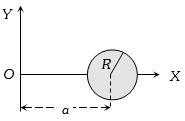
The adjoining figure shows a disc of mass $M$ and radius $R$ lying in the $X-Y$ plane with its centre on $X - $ axis at a distance $a$ from the origin. Then the moment of inertia of the disc about the $X-$ axis is