Questions

M.C.Q (1 Marks)

Take a timed test

17 questions · auto-graded multiple-choice test.

MCQ 11 Mark
If the distance covered by an object is directly proportional to time, then we can say that the object :
  • A
    moves with zero velocity
  • B
    moving at a constant speed
  • C
    acceleration is constant
  • has the same velocity
Answer
Correct option: D.
has the same velocity
d
View full question & answer
MCQ 21 Mark
When an object covers equal distances in equal time intervals, then its speed is:
  • A
    slow motion
  • B
    accelerated pace
  • C
    uneven motion
  • uneven motion
Answer
Correct option: D.
uneven motion
d
View full question & answer
MCQ 31 Mark
When a body thrown vertically upward from the earth's surface is at its maximum height, then its :
  • A
    velocity is maximum
  • B
    acceleration is zero
  • C
    acceleration is maximum
  • velocity is zero
Answer
Correct option: D.
velocity is zero
d
View full question & answer
MCQ 41 Mark
A piece of stone is thrown into the air. Acceleration of stone :
  • A
    will always be upwards
  • will always be downwards
  • C
    It will be upwards in upward journey and downwards in downward journey.
  • D
    It will be downwards in upward journey and upwards in downward journey.
Answer
Correct option: B.
will always be downwards
b
View full question & answer
MCQ 51 Mark
If the displacement of an object is directly proportional to the square of time, then the speed of the object is :
  • with uniform acceleration
  • B
    due to unequal acceleration
  • C
    at uniform speed
  • D
    unequal acceleration but uniform speed
Answer
Correct option: A.
with uniform acceleration
a
View full question & answer
MCQ 61 Mark
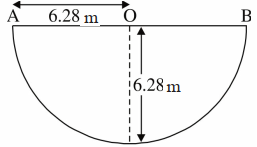
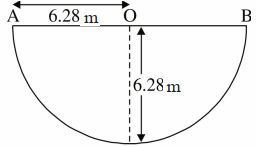
When a particle moving in a circular orbit of radius 6.28 meters reaches from one end of the diameter to the other, then the ratio between the distance covered and the displacement will be :
Image
  • A
    $2 \pi$
  • B
    $\frac{\pi}{2}$
  • $\pi$
  • D
    1
Answer
Correct option: C.
$\pi$
 (c) $\frac{\text { Distance }}{\text { Displacement }}=\frac{\pi r}{2 r}=\frac{\pi}{2}$
Therefore, the correct option is (c).
View full question & answer
MCQ 71 Mark
Displacement x , of a body moving in one-dimensional motion depends on time $t$ as follows : $x=a_0+a_1 t+a_2 t^2+a_3 t^3$ where $a_0, a_1, a_2, a_3$ are fixed.
Then the correct statement is :
  • A
    The position of the particle is $a _1$.
  • B
    The initial velocity of the particle is $2 a _2$.
  • The acceleration of the particle is not constant.
  • D
    Position time curve is a straight line.
Answer
Correct option: C.
The acceleration of the particle is not constant.
(c)  $
x=a_0+a_1 t+a_2 t^2+a_3 t^3
$
Position $t =0$
$
\begin{aligned}
& =a_0 \\
v & =\frac{d x}{d t}=a_1+2 a_2 t+3 a_3 t^2
\end{aligned}
$
Velocity $t =0$
$
v=a_1
$
Acceleration $a =\frac{ dv }{ dt }=2 a _2+6 a _3 t$
Here, acceleration depends on time, hence it is not constant. Hence the correct option is (c).
View full question & answer
MCQ 81 Mark
When a ball is thrown vertically upward with velocity $u$, it rises to a height $h$. If it is thrown with velocity $2 u$ then the height obtained will be :
Answer
Correct option: C.
 (c ) $\ v ^2= u ^2-2 gh$
$0= u ^2-2 gh$
$h =\frac{ u ^2}{2 g} \quad$ Now, $u =2 u$
Then $h ^{\prime}=\frac{(2 u )^2}{2 g}=4 \frac{ u ^2}{2 g}$
$h^{\prime}=4 h
$
Therefore, the correct option is (c).
View full question & answer
MCQ 91 Mark
The ratio of distances covered by a freely falling object in its first and second second is:
  • A
    $1: 2$
  • $1: 3$
  • C
    $3: 2$
  • D
    $1: \sqrt{3}$
Answer
Correct option: B.
$1: 3$
 (b) Distance covered in $n ^{\text {th }}$ second
$\begin{array}{rlr} s _{ n } & = u +\frac{1}{2} a (2 n -1) &
\\ s _1 & =0+\frac{1}{2} a & ( n =1)
\\ s _2 & =0+\frac{3}{2} a \\ s _1: s _2 & =1: 3 & ( n =2)\end{array}$
Hence the correct option is (b).
View full question & answer
MCQ 101 Mark
A stone of 1 kg and another stone of 2 kg are simultaneously released freely from the same height. What will be the ratio of time taken by the stones to fall on the earth?
  • $1: 1$
  • B
    $1: \sqrt{2}$
  • C
    $1: 2$
  • D
    $1: 3$
Answer
Correct option: A.
$1: 1$
a
View full question & answer
MCQ 111 Mark
If the mutual graph of two quantities is a straight line, then both the quantities:
  • A
    are constant
  • B
    are equal
  • are sequentially
  • D
    are inversely proportional
Answer
Correct option: C.
are sequentially
View full question & answer
MCQ 121 Mark
The acceleration of a moving object can be determined by:
  • A
    the slope of distance-time graph
  • the slope of velocity-time graph
  • C
    the area of the velocity-time graph
  • D
    the area of the distance-time graph
Answer
Correct option: B.
the slope of velocity-time graph
b
View full question & answer
MCQ 131 Mark
The instantaneous velocity of a body can be measured:
  • by speedometer
  • B
    by graph
  • C
    by vector method
  • D
    none of these
Answer
Correct option: A.
by speedometer
a
View full question & answer
MCQ 141 Mark
The distance covered by a particle moving with initial velocity and acceleration a in the $x ^{\text {th }}$ second will be :
  • A
    $u+\frac{3}{2}(2 x-1)$
  • B
    $u+\frac{a}{2}(2 x+1)$
  • C
    $u+a(2 x-1)$
  • $u+\frac{a}{2}(2 x-1)$
Answer
Correct option: D.
$u+\frac{a}{2}(2 x-1)$
d
View full question & answer
MCQ 151 Mark
A ball is thrown vertically upward with a velocity of $19.6 m / s$. In how many seconds will the ball reach its maximum height?
  • A
    1
  • 2
  • C
    3
  • D
    4
Answer
Correct option: B.
2
(b) Final velocity at maximum height
$
\begin{array}{c}
v=0, \\
g=9.8 m / s^2
\end{array}
$
From the first equation of motion
$
\begin{array}{l}
v=u-gt \\
t=\frac{u-v}{g}=\frac{19.6-0}{9.8} \\
t=2 \text { second }
\end{array}
$
Hence the correct option is (b).
View full question & answer
MCQ 161 Mark
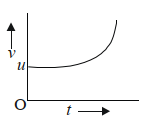
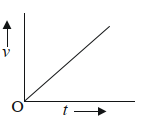
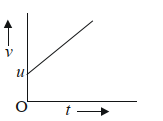
The velocity-time graph of a particle moving with initial velocity u and uniform acceleration a is:
  • A
    Image
  • B
    Image
  • Image
  • D
    Image
Answer
Correct option: C.
Image
c
View full question & answer
MCQ 171 Mark
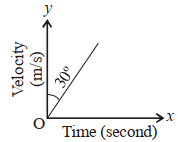
The velocity-time graph for one-dimensional motion of a particle is as shown in the figure. The acceleration of the particle is (in $m / s ^2$ ):
Image
Answer
Correct option: A.
 (a) Acceleration $a=\frac{ dv }{ dt }=\tan \theta$
Here, $\theta$ is the angle made with the x axis.
$\begin{array}{ll}
\therefore \quad & \theta=90^{\circ}-30^{\circ}=60^{\circ} \\
& a=\tan 60^{\circ}=\sqrt{3}
\end{array}$
Hence, the correct option is (a).
View full question & answer