If the equation of transverse wave is $Y = 2\sin (kx - 2t),$ then the maximum particle velocity is .... $units$
Easy
Download our app for free and get started
(a) Maximum particle velocity $ = a\omega = 2 \times 2 = 4\,units$.

Download our appand get started for free
Experience the future of education. Simply download our apps or reach out to us for more information. Let's shape the future of learning together!No signup needed.*
Similar Questions
- 1Two identical flutes produce fundamental notes of frequency $300 Hz$ at ${27^o} C.$ If the temperature of air in one flute is increased to ${31^o}$C, the number of the beats heard per second will beView Solution
- 2If $v$ is the speed of sound in air then the shortest length of the closed pipe which resonates to a frequency $n$View Solution
- 3Two waves ${y_1} = {A_1}\sin (\omega t - {\beta _1})$, ${y_2} = {A_2}\sin (\omega t - {\beta _2})$ Superimpose to form a resultant wave whose amplitude isView Solution
- 4A plane progressive wave is represented by the equation $y = 0.1\sin \left( {200\pi t - \frac{{20\pi x}}{{17}}} \right)$ where y is displacement in $m$, $ t$ in second and $x$ is distance from a fixed origin in meter. The frequency, wavelength and speed of the wave respectively areView Solution
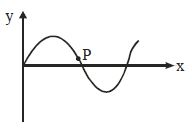
- 5A transverse sinusoidal wave moves along a string in the positive $x-$ direction at a speed of $10\, cm/s$. The wavelength of the wave is $0.5\, m$ and its amplitude is $10\, cm$. At a prticular time $t$, the snap-shot of the wave is shown in the figure. the velocity of point $P$ when its displacement is $5\, cm$, isView Solution
- 6The equations of two waves acting in perpendicular directions are given as $x=a \cos (\omega t+\delta)$ and $y=a \cos (\omega t+\alpha)$, where $\delta=\alpha+\frac{\pi}{2}$, the resultant wave representsView Solution
- 7Two engines pass each other moving in opposite directions with uniform speed of $30\,m/s$ . One of them is blowing a whistle of frequency $540\,Hz.$ Calculate the frequency heard by driver of second engine before they pass each other ... $Hz$. Speed of sound is $330\,m/sec$View Solution
- 8Two vibrating tuning forks produce progressive waves given by ${y_1} = 4\,\sin \,\left( {500\pi t} \right)$ and ${y_2} = 2\,\sin \,\left( {506\pi t} \right)$. These tuning forks are held near the ear of a person. The person will hear $\alpha \, beats/s$ with intensity ratio between maxima and minima equal to $\beta $. Find the value of $\beta - \alpha $View Solution
- 9The speed of a wave in a certain medium is $960\, m/s$. If $3600$ waves pass over a certain point of the medium in $1\, minute$, the wavelength is .... $metres$View Solution
- 10$Assertion :$ Sound waves cannot travel in vacuum but light can travel in vacuum.View Solution
$Reason :$ Sound waves are longitudinal waves and they cannot be polarised but electromagentic waves are transverse and they can be polarised.