If the equation of transverse wave is $y = 5\sin 2\pi \left[ {\frac{t}{{0.04}} - \frac{x}{{40}}} \right]$, where distance is in $ cm$ and time in second, then the wavelength of the wave is .... $cm$
Easy


Download our appand get started for free
Experience the future of education. Simply download our apps or reach out to us for more information. Let's shape the future of learning together!No signup needed.*
Similar Questions
- 1The $(x, y)$ coordinates of the corners of a square plate are $(0, 0), (L, 0), (L, L)$ and $(0, L).$ The edges of the plate are clamped and transverse standing waves are set up in it. If $u(x, y)$ denotes the displacement of the plate at the point $(x, y)$ at some instant of time, the possible expression(s) for $u$ is(are) ($a =$ positive constant)View Solution
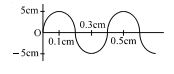
- 2Figure shown the shape of part of a long string in which transverse waves are produced by attaching one end of the string to tuning fork of frequency $250 Hz$. What is the velocity of the waves .... $ms^{-1}$ ?View Solution
- 3$Assertion :$ Doppler formula for sound wave is symmetric with respect to the speed of source and speed of observer.View Solution
$Reason :$ Motion of source with respect to stationary observer is not equivalent to the motion of an observer with respect to stationary source. - 4A boat at anchor is rocked by waves whose crests are $100\, m$ apart and velocity is $25\, m/sec$. The boat bounces up once in every: ... $sec$View Solution
- 5View SolutionIf the temperature of the atmosphere is increased the following character of the sound wave is effected
- 6If the equation of transverse wave is $y = 5\sin 2\pi \left[ {\frac{t}{{0.04}} - \frac{x}{{40}}} \right]$, where distance is in $ cm$ and time in second, then the wavelength of the wave is .... $cm$View Solution
- 7A source of sound emits waves with frequency $f \,Hz$ and speed $V\, m/sec$. Two observers move away from this source in opposite directions each with a speed $0.2\, V$ relative to the source. The ratio of frequencies heard by the two observers will beView Solution
- 8The equation of a plane progressive wave is given by $y = 0.025\sin (100t + 0.25x)$. The frequency of this wave would beView Solution
- 9Two waves of amplitudes $A_0$ and $x A_0$ pass through a region. If $x > j _0$ the difference in the maximum and minimum resultant amplitude possible isView Solution
- 10View Solutionstationary source is emitting sound at a fixed frequency $f_0$, which is reflected by two cars approaching the source. The difference between the frequencies of sound reflected from the cars is $1.2\%$ of $f_0$. What is the difference in the speeds of the cars (in $km$ per hour) to the nearest integer ..... $km/hr$ ? The cars are moving at constant speeds much smaller than the speed of sound which is $330$ $ms^{-1}$.