Question
If the escape velocity of a satellite at a height above the earth's surface is $v=\sqrt{\frac{2 G M}{R}}$. Then check the correctness of the formula.

Answer

It is given, $\quad v=\sqrt{\frac{2 GM }{ R }}$
Dimension of velocity $(v)$ in left side $=\left[ M ^0 L^1 T^{-1}\right]$
Dimension of right side $=\sqrt{\frac{2 GM }{ R }}$
$=\sqrt{\frac{\left[ M ^{-1} L^3 T^{-2}\right][ M ]}{[ L ]}}$
$=\sqrt{\left[ M ^0 L^2 T^{-2}\right]}=\left[ M ^0 L^{ l } T ^{-1}\right]$
$\therefore$ Dimension of left side $=$ Dimension of right side
So, the given formula is correct.

Need a full question paper?

Generate a complete, print-ready paper with questions like this in minutes — across 16+ boards, with answer keys.
Start Generating Free

Similar questions

A brass plate having surface area $200cm^2$ on one side is electroplated with $0·10mm$ thick silver layers on both sides using a $15A$ current. Find the time taken to do the job. The specific gravity of silver is $10.5$ and its atomic weight is $107.9 g/mol$.
A uniform electric field of $10 \mathrm{NC}^{-1}$ exists in the vertically downward direction. Find the increase in the electric potential as one goes up through a height of 50cm.
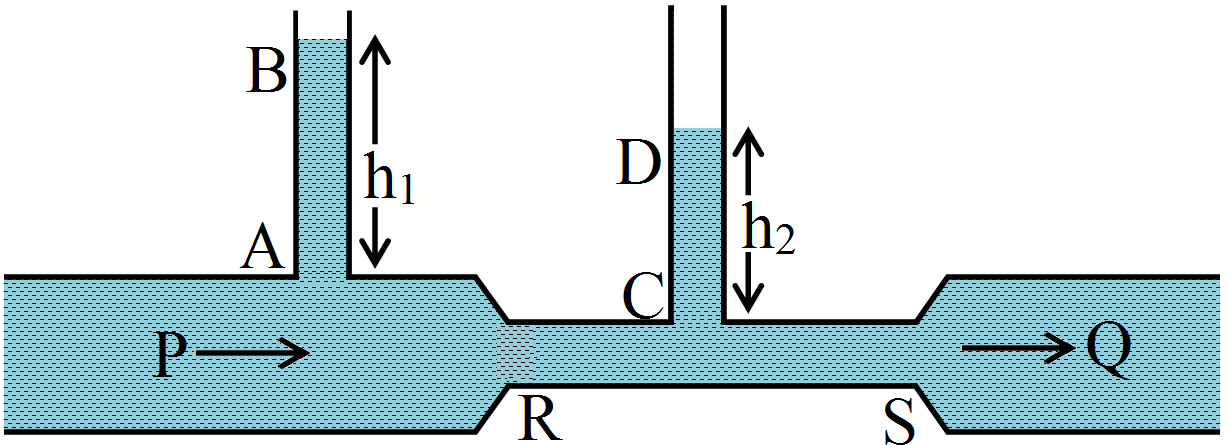
As shown in figure, water flows from P to Q. Explain why height h, of column AB of water is greater than height h, of column CD of water.
Given below are some functions of x and t to represent the displacement of an elastic wave.
$​​​​\text{y}=10\cos[(252-250)\pi\text{t}]\cos[(252+250)\pi\text{t}]$
In what ways are the gas thermometers superior to mercury thermometers?
Find the average magnitude of linear momentum of a helium molecule in a sample of helium gas at $0^{\circ} \mathrm{C}$. Mass of a helium molecule $=6.64 \times 10^{-27} \mathrm{~kg}$ nd Boltzmann constant $=1.38 \times 10^{-23} \mathrm{JK}^{-1}$.
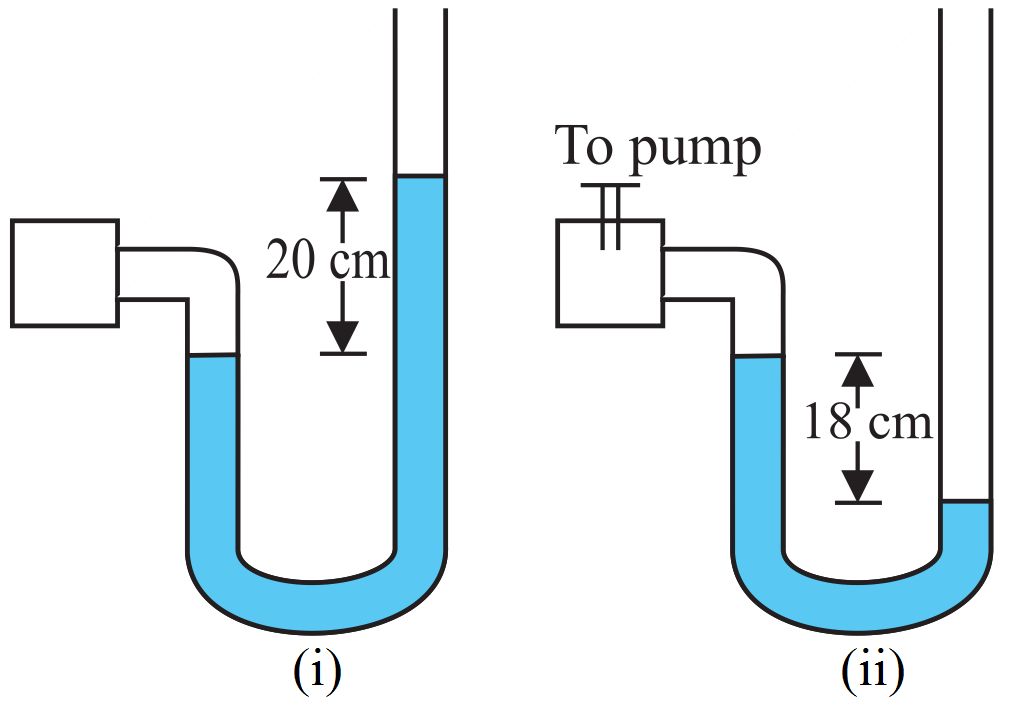
A manometer reads the pressure of a gas in an enclosure as shown in Fig.$(a)$ When a pump removes some of the gas, the manometer reads as in Fig. $(b)$ The liquid used in the manometers is mercury and the atmospheric pressure is $76\ cm$ of mercury. Give the absolute and gauge pressure of the gas in the enclosure for cases $(i)$ and $(ii)$ in units of cm of mercury. How would the levels change in case $(i)$ if $13.6\ cm$ of water $($immiscible with mercury$)$ are poured into the right limb of the manometer? $($Ignore the small change in volume of the gas.$)$
It is easier to pull a lawn roller than to push it. Why?
If work required to blow a soap bubble of radius r is W, then what additional work is required to be done to blow it to a radius 3r?
If air is blow speedily below a pan of a balance of physical balance what would be the effect on its balance?