If the image formed by a lens for all positions of the object placed in front of it is always virtual, erect and diminished, state the type of the lens. Draw a ray diagram in support of your answer. If the numerical value of focal length of such a lens is 20 cm, find its power in new cartesian sign conventions.
CBSE FOREIGN - SET 3 2016
Download our app for free and get started
Diverging lens/ concave lens
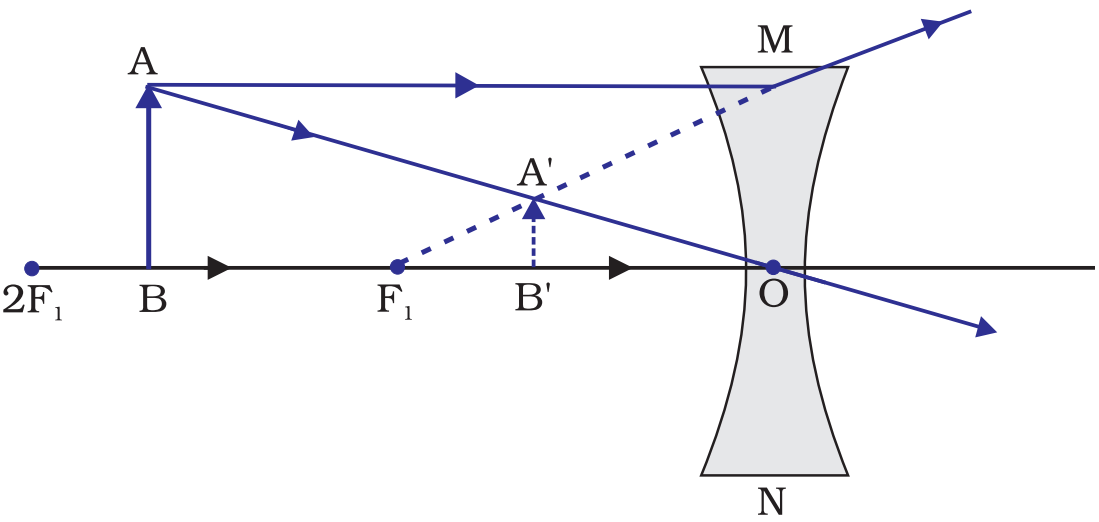
We know that, $\text{P}=\frac{1}{\text{f meter}}$
When we convert 20cm into meter, we get 0.2m
Therefore, $\text{P}=\frac{1}{0.2 \text{ meter}}$
or, P = 5m.
We know that, $\text{P}=\frac{1}{\text{f meter}}$
When we convert 20cm into meter, we get 0.2m
Therefore, $\text{P}=\frac{1}{0.2 \text{ meter}}$
or, P = 5m.

Download our appand get started for free
Experience the future of education. Simply download our apps or reach out to us for more information. Let's shape the future of learning together!No signup needed.*
Similar Questions
- 1View SolutionAn image formed on a screen is three times the size of the object. The object and screen are 80cm apart when the image is sharply focussed.
- State which type of lens is used.
- Calculate focal length of the lens.
- 2View SolutionA person got his eyes tested by an optician. The prescription for the spectacle lenses to be made reads:
Left eye: +2.50D, Right eye: +2.00D- State whether these lenses are thicker in the middle or at the edges.
- Which lens bends the light rays more strongly?
- State whether these spectacle lenses will converge light rays or diverge light rays.
- 3View SolutionThe radius of curvature of a concave mirror is 50cm. Where should an object be placed in the mirror, so as to form its image at infinity? Justify your answer.
- 4View SolutionThe shiny outer surface of a hollow sphere of aluminium of radius 50cm is to be used as a mirror:
- What will be the focal length of this mirror?
- Which type of spherical mirror will it provide?
- State whether this spherical mirror will diverge or converge light rays.
- 5View SolutionAn object 2cm tall stands on the principal axis of a converging lens of focal length 8cm. Find the position, nature and size of the image formed if the object is:
- 12cm from the lens.
- 6 cm from the lens.
- 6View SolutionAn erect image 2.0cm high is formed 12cm from a lens, the object being 0.5cm high. Find the focal length of the lens.
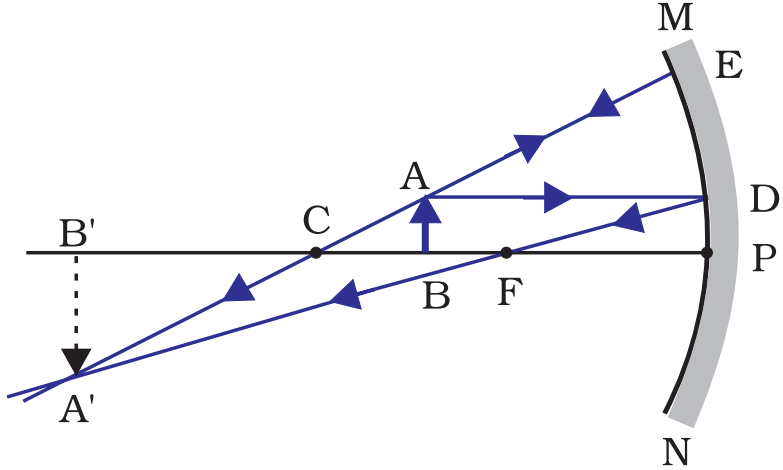
- 7View SolutionDraw the ray diagram in your answer book and show the formation of image of object AB with suitable rays. Mention the position and nature of image.
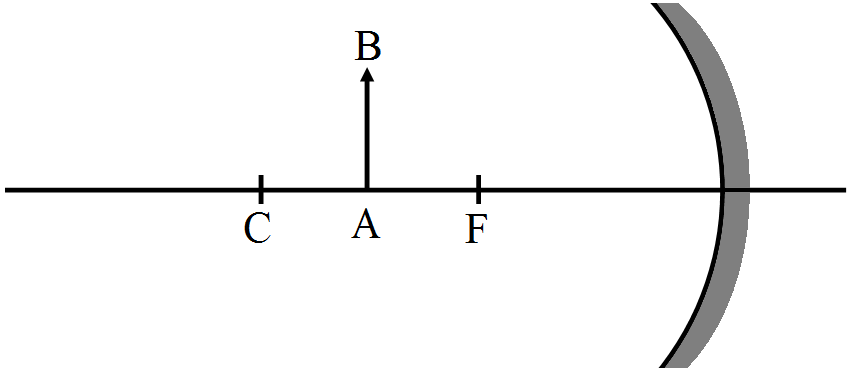
- 8The refractive indices of water and glass are $\frac{3}{4}\text{ and }\frac{3}{2}$ respectively. Write the relation and find the value of refractive index of water with respect to glass and glass with respect to water.View Solution
- 9View SolutionThe two rays chosen for the construction of ray diagram is:
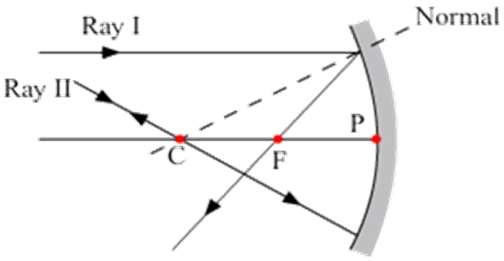
Ray 1: When the incident ray is parallel to the principal axis, the reflected ray will pass through the focus of concave mirror or it appears to pass through the focus of convex mirror.
Ray 2: When the incident ray passes through or appears to pass through the centre of curvature, the light, after reflection from the spherical mirror, reflects back along the same path.
The image formed is real, inverted, magnified and is formed beyond the centre of curvature.
- 10View SolutionA student wants to project the image of a candle flame on a screen 48 cm in front of a mirror by keeping the flame at a distance of 12 cm from its pole.
- Suggest the type of mirror he should use.
- Find the linear magnification of the image produced.
- How far is the image from its object?
- Draw ray diagram to show the image formation in this case.