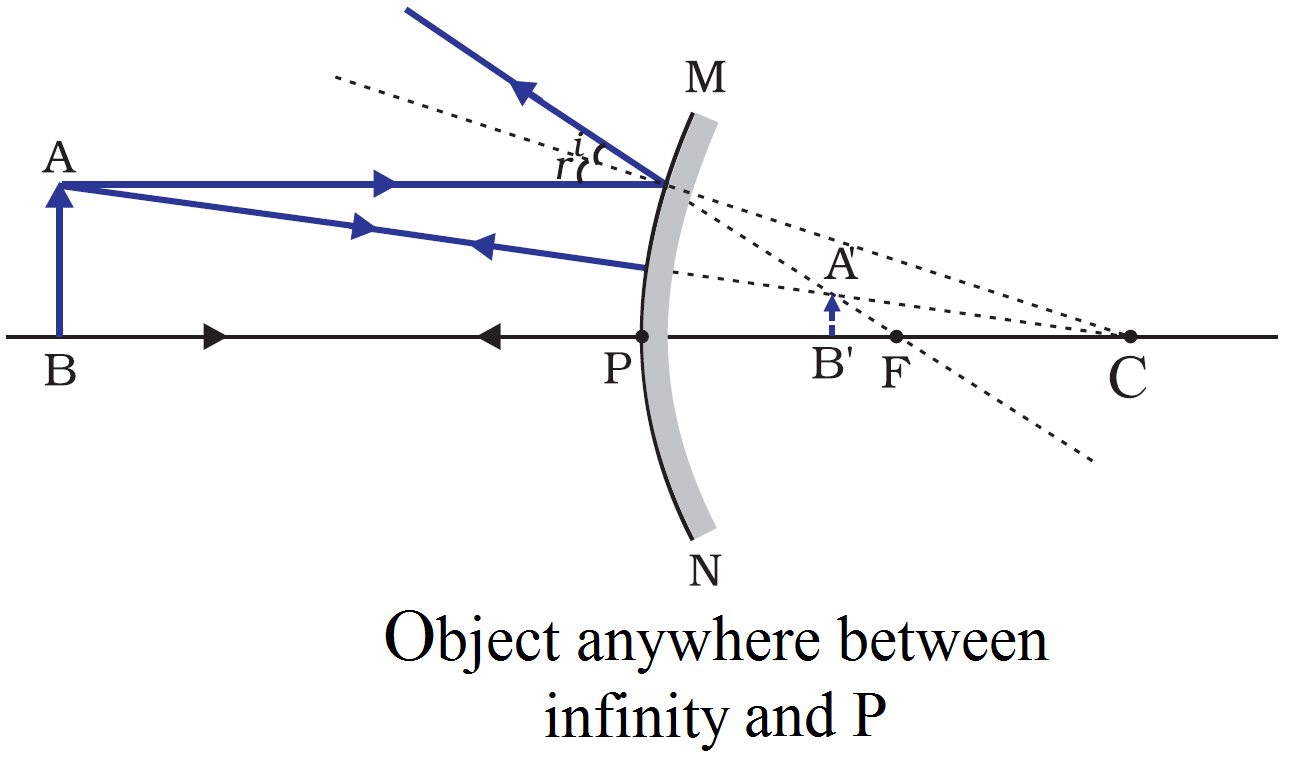
If the image formed by a spherical mirror for all positions of the object placed in front of it is always erect and diminished, what type of mirror is it? Draw a labelled ray diagram to support your answer.
CBSE DELHI - OUTSIDE DELHI - FOREIGN SET 1 2018
Download our app for free and get started
The image formed by a convex mirror is always virtual, erect and diminished, irrespective of the position of the object. Hence, the mirror is a convex mirror.

Download our appand get started for free
Experience the future of education. Simply download our apps or reach out to us for more information. Let's shape the future of learning together!No signup needed.*
Similar Questions
- 1View SolutionList two properties of the images formed by convex mirrors. Draw ray diagram in support of your answer.
- 2View SolutionA convex mirror used as a rear-view mirror in a car has a radius of curvature of 3m. If a bus is located at a distance of 5m from this mirror, find the position of image. What is the nature of the image?
- 3View SolutionIt is desired to obtain an erect image of an object, using concave mirror of focal length of 12cm.
Where will the image of this object be, if it is placed 24cm in front of the mirror? Draw ray diagram for this situation also to justify your answer.
Show the positions of pole, principal focus and the centre of curvature in the above ray diagrams. - 4View SolutionA ray of light travelling in air enters obliquely into water. Does the light ray bend towards the normal or away from the normal? Why?
- 5View SolutionThe linear magnification produced by a spherical mirror is +3. Analyse this value and state the (i) type of mirror and (ii) position of the object with respect to the pole of the mirror. Draw ray diagram to show the formation of image in this case.
- 6View SolutionHow could you find the focal length of a convex lens rapidly but approximately?
- 7View Solution‘‘A concave mirror of focal length 15cm can form a magnified erect as well as inverted image of an object placed in front of it.’’ Justify this statement stating the position of the object with respect to the pole of the mirror in both cases for obtaining the images.
- 8View SolutionAn object of height 2.5 cm is placed at a distance of 15 cm from the optical centre ‘O' of a convex lens of focal length 10 cm. Draw a ray diagram to find the position and size of the image formed. Mark optical centre ‘O', principal focus F and height of the image on the diagram.
- 9View SolutionAn object lies at a distance of 2f from a concave lens of focal length f. Draw a ray-diagram to illustrate the image formation.
- 10View SolutionWhich kind of mirrors are used in the headlights of a motorcar and why?