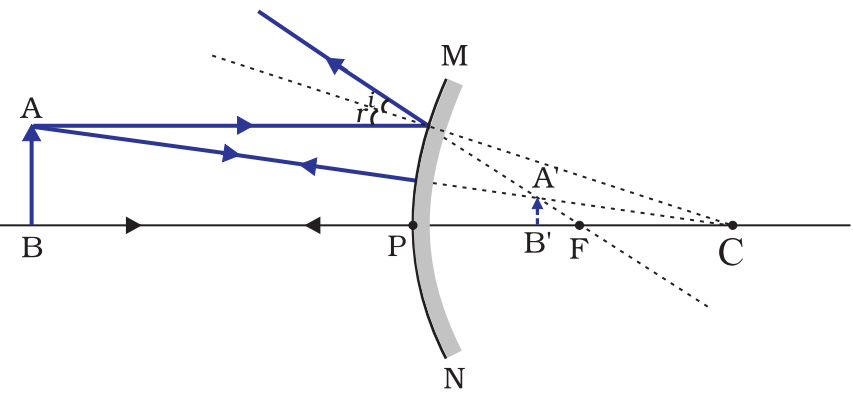
List two properties of the images formed by convex mirrors. Draw ray diagram in support of your answer.
CBSE FOREIGN - SET 2 2016
Download our app for free and get started
The images formed by convex mirrors are: Virtual, erect and smaller than the object.

Download our appand get started for free
Experience the future of education. Simply download our apps or reach out to us for more information. Let's shape the future of learning together!No signup needed.*
Similar Questions
- 1View SolutionState and define the S.I. unit of power of a lens.
- 2View SolutionIdentify the device used as a spherical mirror or lens in following cases, when the image formed is virtual and erect in each case.Object is placed between the focus and device, image formed is enlarged and on the same side as that of the object.
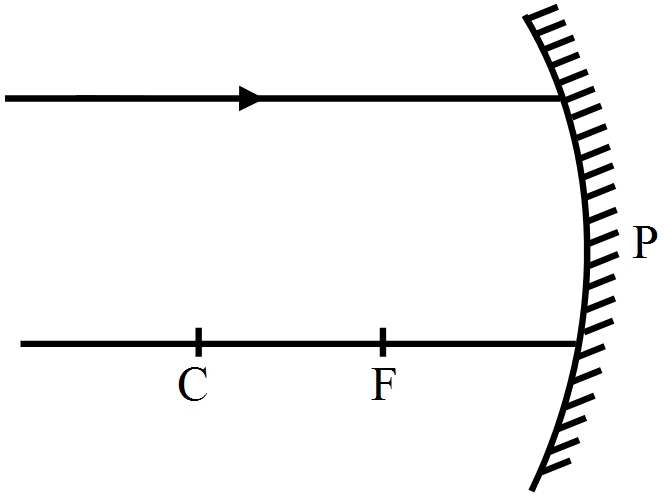
- 3Redraw the following diagram on your answer sheet and show the path of the reflected ray. Also mark the angle of incidence $(\angle\text{i})$ and the angle of reflection $(\angle\text{r})$ on the diagram.View Solution
- 4View SolutionThree convex lenses are available having focal lengths of 4cm, 40cm and 4m respectively. Which one would you choose as a magnifying glass and why?
- 5View SolutionA concave mirror and a convex lens are held separately in water. What changes, if any, do you expect in the focal length of either?
- 6View SolutionWhich type of mirror is used in a solar furnace? Support your answer with reason.
- 7View SolutionState and explain the laws of refraction of light with the help of a labelled diagram.
- 8View SolutionState two factors on which the lateral displacement of the emergent ray depends.
- 9View SolutionExplain why, concave mirrors are used as shaving mirrors.
- 10View SolutionA star appears slightly higher (above) than its actual position in the sky illustrate it with the help of a labelled diagram.