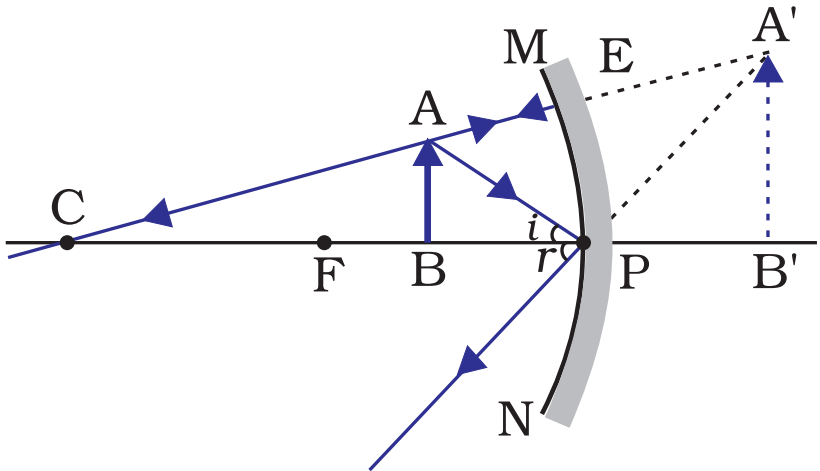
The linear magnification produced by a spherical mirror is +3. Analyse this value and state the (i) type of mirror and (ii) position of the object with respect to the pole of the mirror. Draw ray diagram to show the formation of image in this case.
CBSE FOREIGN - SET 3 2016
Download our app for free and get started
- Concave mirror.
- Between the pole and focus.

Download our appand get started for free
Experience the future of education. Simply download our apps or reach out to us for more information. Let's shape the future of learning together!No signup needed.*
Similar Questions
- 1View SolutionYour eye contains a convex lens. Why is it unwise to look at the sun?
- 2View SolutionA communications satellite in orbit sends a parallel beam of signals down to earth. If these signals obey the same laws of reflection as light and are to be focussed onto a small receiving aerial, what should be the best shape of the metal 'dish' used to collect them?
- 3View SolutionHow will you distinguish between a plane mirror, a concave mirror and a convex mirror without touching them?
- 4View SolutionList four specific characteristics of the images of the objects formed by convex mirrors.
- 5View SolutionGive two uses of a convex mirror. Explain why you would choose convex mirror for these uses.
- 6View SolutionDraw a diagram to represent a convex mirror. On this diagram mark principal axis, principal focus F and the centre of curvature C if the focal length of convex mirror is 3cm.
- 7View SolutionIf an object is placed at a distance of 8cm from a concave mirror of focal length 10cm, discuss the nature of the image formed by drawing the ray diagram.
- 8View SolutionAn object of height 4.0cm is placed at a distance of 30cm from the optical centre ‘O’ of a convex lens of focal length 20cm. Draw a ray diagram to find the position and size of the image formed. Mark optical centre ‘O’ and principal focus ‘F’ on the diagram. Also find the approximate ratio of size of the image to the size of the object.
- 9View SolutionA convex lens is immersed in a liquid of refractive index greater than that of glass. How will the nature of lens change?
- 10View SolutionDraw ray diagrams showing the image formation by a convex mirror when an object is placed:
At finite distance from the mirror.