If the interatomic spacing in a steel wire is $3.0Å$ and ${Y_{steel}}$= $20 \times {10^{10}}N/{m^2}$ then force constant is
Medium
Download our app for free and get started
(b)$K = Y{r_0} = 20 \times {10^{10}} \times 3 \times {10^{ - 10}} = 60\;N/m$
$ = 6 \times {10^{ - 9}}N/{Å}$
$ = 6 \times {10^{ - 9}}N/{Å}$

Download our appand get started for free
Experience the future of education. Simply download our apps or reach out to us for more information. Let's shape the future of learning together!No signup needed.*
Similar Questions
- 1A wire of length $L$ and radius $r$ is clamped at one end. If its other end is pulled by a force $F$, its length increases by $l$. If the radius of the wire and the applied force both are reduced to half of their original values keeping original length constant, the increase in length will become.View Solution
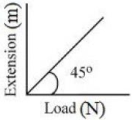
- 2As shown in the figure, in an experiment to determine Young's modulus of a wire, the extension-load curve is plotted. The curve is a straight line passing through the origin and makes an angle of $45^{\circ}$ with the load axis. The length of wire is $62.8\,cm$ and its diameter is $4\,mm$. The Young's modulus is found to be $x \times$ $10^4\,Nm ^{-2}$. The value of $x$ isView Solution
- 3If the volume of the given mass of a gas is increased four times, the temperature is raised from $27°C$ to $127°C.$ The elasticity will becomeView Solution
- 4Auniform rod rotating in gravity free region with certain constant angular velocity. The variation of tensile stress with distance $x$ from axis of rotation is best represented by which of the following graphs.View Solution
- 5Steel and copper wires of same length are stretched by the same weight one after the other. Young's modulus of steel and copper are $2 \times {10^{11}}\,N/{m^2}$ and $1.2 \times {10^{11}}\,N/{m^2}$. The ratio of increase in lengthView Solution
- 6Young's modulus is determined by the equation given by $\mathrm{Y}=49000 \frac{\mathrm{m}}{\ell} \frac{\text { dyne }}{\mathrm{cm}^2}$ where $\mathrm{M}$ is the mass and $\ell$ is the extension of wre used in the experiment. Now error in Young modules $(\mathrm{Y})$ is estimated by taking data from $M-\ell$ plot in graph paper. The smallest scale divisions are $5 \mathrm{~g}$ and $0.02$ $\mathrm{cm}$ along load axis and extension axis respectively. If the value of $M$ and $\ell$ are $500 \mathrm{~g}$ and $2 \mathrm{~cm}$ respectively then percentage error of $\mathrm{Y}$ is :View Solution
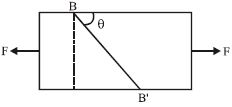
- 7A bar of cross-sectional area $A$ is subjected two equal and opposite tensile forces at its ends as shown in figure. Consider a plane $BB'$ making an angle $\theta $ with the length The ratio of tensile stress to the shearing stress on the plane $BB'$ isView Solution
- 8Two steel wires of same length but radii $r$ and $2r$ are connected together end to end and tied to a wall as shown. The force stretches the combination by $10\ mm$. How far does the midpoint $A$ move ............ $mm$View Solution

- 9A cubical solid aluminium (bulk modulus $=-V \frac{ dP }{ dV }=70 GPa$ ) block has an edge length of $1 m$ on the surface of the earth. It is kept on the floor of a $5 km$ deep ocean. Taking the average density of water and the acceleration due to gravity to be $10^3 kg m ^{-3}$ and $10 ms ^{-2}$, respectively, the change in the edge length of the block in $mm$ is . . . . .View Solution
- 10A uniform wire of length $L$ and radius $r$ is twisted by an angle $\alpha$. If modulus of rigidity of the wire is $\eta$, then the elastic potential energy stored in wire, is .........View Solution