Question
If the kinetic energy of a light and heavy body is equal, then whose momentum is less?

Answer

  Let
$\begin{aligned} m _1 & > m _2 \\ \frac{1}{2} m_1 v _1^2 & =\frac{1}{2} m_2 v _2^2 \\ \frac{m_1}{m_2} & =\left(\frac{ v _2}{ v _1}\right)^2\end{aligned}$
Hence, $\quad\left( m _1 v_1\right) v _1=\left( m _2 v_2\right) v_2$
Hence, $\quad P _1 v _1= P _2 v _2$
But,
$\frac{v_2}{v_1}=\sqrt{\frac{m_1}{m_2}}=\frac{P_1}{P_2}$

But, $m_1>m_2$ so $v _2> v _1$

Hence,$P_1>P_2$

Need a full question paper?

Generate a complete, print-ready paper with questions like this in minutes — across 16+ boards, with answer keys.

Start Generating Free

Explore more

Similar questions

Two springs $A$ and $B$ are similar in all respects, but spring $A$ is stiffer than $B$, i.e., $K_A>k_B$, on which spring more work will be done if :
(a) both should be drawn to equal length,
(b) both should be pulled with equal force?
There are equal number of molecules of $H _2$ and $O _2$ in a vessel. If there is a tiny hole in the vessel, which gas will leak faster?
The pressures of the gas in a constant volume gas thermometer are 80cm, 90cm and 100cm of mercury at the ice point, the steam point and in a heated wax bath, respectively. Find the temperature of the wax bath.
Define reversible and irreversible actions and write one example of each.
Two wires A and B are of the same material. Their lengths are in the ratio $1 : 2$ and the diameters in the ratio $2 : 1$ If they are pulled by the same force, then what will be the ratio of their increase in lengths?
A point charge Q is placed at the origin. Find the electrostatic energy stored outside the sphere of radius R centred at the origin.
If the resultant torque of all the forces acting on a body is zero about a point, is it necessary that it will be zero about any other point?
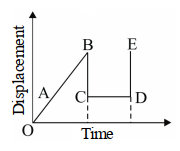
The figure show the displacement-time graph for an imaginary one-dimensional motion. Explain why this type of motion is not possible?
Image
An object of 2 kg falls into the sand from a height of 10 m . If the object moves 2 cm in the sand before coming to rest, what will be the average resistance force? $\left(g=10 m / s ^2\right)$
If the length and time period of an oscillating pendulum have errors of 1% and 2% respectively, what is the error in the estimate of g?