Question
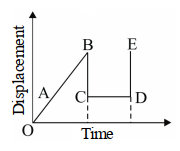
The figure show the displacement-time graph for an imaginary one-dimensional motion. Explain why this type of motion is not possible?
Image

Answer

There are two parts of the time-displacement graph in the figure, they are displayed by two vertical lines. It is clear from the figure that the velocity of the object is infinite in two zero intervals since the velocity of an object cannot exceed the speed of light, the time displacement of the object is not correct.

Need a full question paper?

Generate a complete, print-ready paper with questions like this in minutes — across 16+ boards, with answer keys.
Start Generating Free

Similar questions

A transverse harmonic wave on a string is described by
$\text{y}(\text{x, t})=3.0\sin\big(36\text{t}+0.018\text{x}+\frac{\pi}{4}\big)$
where x and y are in cm and t in s. The positive direction of x is from left to right.
What is the least distance between two successive crests in the wave?
The torque of a force $\overrightarrow{\text{F}}$ about a point is defined as $\overrightarrow{\text{r}}=\overrightarrow{\text{r}}\times\overrightarrow{\text{F}}.$ Suppose $\overrightarrow{\text{r}}, \overrightarrow{\text{F}}$and $\overrightarrow{\text{r}}$ are all nonzero. Is $\text{r}\times\overrightarrow{\text{r}}\Bigg|\Bigg|\overrightarrow{\text{F}}$ always true? Is it ever true?
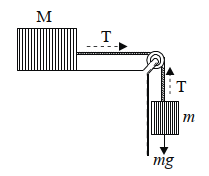
According to the figure, if the coefficient of static friction between block of mass 2 kg and the table is $\mu_s=0.2$ then what should be the maximum value of $m$ so that the block does not move while the pulley is light and frictionless.
Image
What happens when a light sphere collides head-on with a more massive sphere initially at rest?
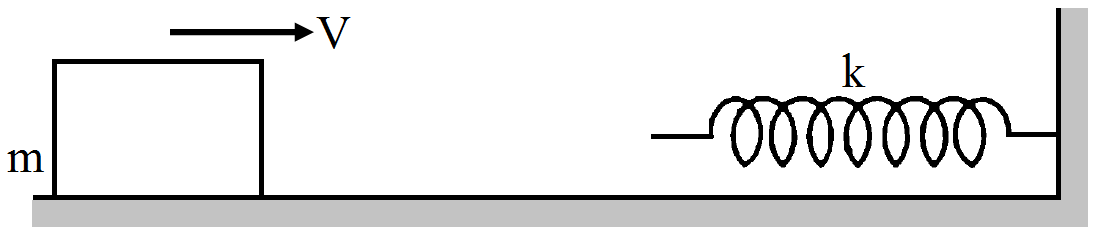
A block of massip, sliding on a smooth horizontal surface with a velocity $\vec{\text{v}}$ meets a long horizontal spring fixed at one end and having spring constant k as shown in figure. Find the maximum compression of tin spring. Will the velocity of the block be the same $\vec{\text{v}}$ when it comes back to the original position shown?
A heavy particle of mass m falls freely near the earth's surface. What is the torque acting on this particle about a point 50cm east to the line of motion? Does this torque produce any angular acceleration in the particle?
An object whose volume is $100 cm^3$ is completely immersed in water. Find the buoyant force on the object.
Is a slow process always isothermal? ls a quick process always adiabatic?
The apparent weight of an object increases in an elevator while accelerating upward. A moongphaliwala sells his moongphali using a beam balance in an elevator. Will he gain more if the elevator is accelerating up?
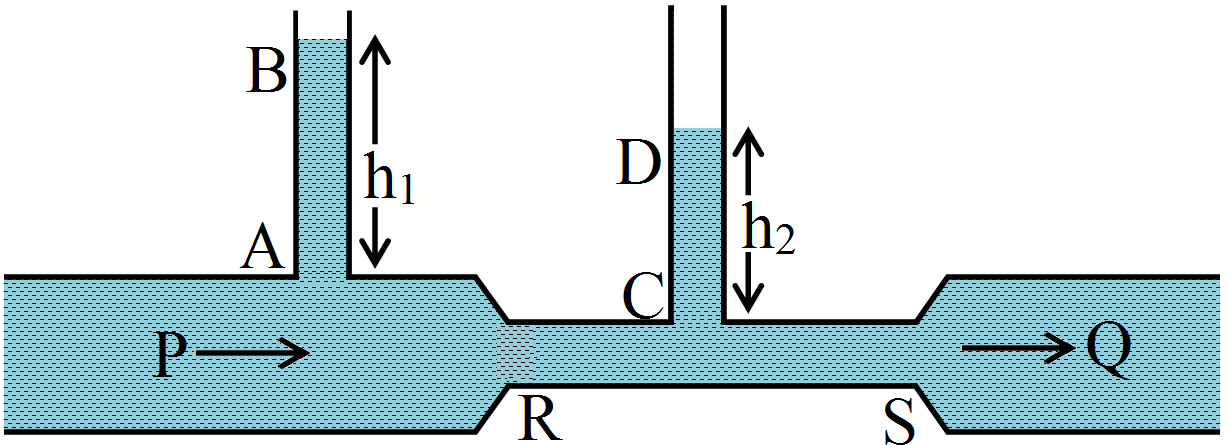
As shown in figure, water flows from P to Q. Explain why height h, of column AB of water is greater than height h, of column CD of water.