If the length of a closed organ pipe is $1m $ and velocity of sound is $330 m/s$, then the frequency for the second note is
Easy
Download our app for free and get started
(b)For closed pipe ${n_1} = \frac{v}{{4l}} = \frac{{330}}{4}$$Hz$
Second note = $3{n_1} = \frac{{3 \times 300}}{4}$$Hz$.
Second note = $3{n_1} = \frac{{3 \times 300}}{4}$$Hz$.

Download our appand get started for free
Experience the future of education. Simply download our apps or reach out to us for more information. Let's shape the future of learning together!No signup needed.*
Similar Questions
- 1View SolutionIf you set up the seventh harmonic on a string fixed at both ends, how many nodes and antinodes are set up in it
- 2A car moves towards a hill with speed $v_c$. It blows a horn of frequency $f$ which is heared by an observer following the car with speed $v_0$. The speed of sound in air is $v$.View Solution
- 3A travelling wave passes a point of observation. At this point, the time interval between successive crests is $0.2$ seconds andView Solution
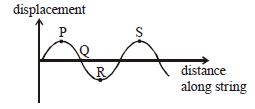
- 4The given graph illustrates a transverse wave travelling on a string at a particular instant, and the points $P, Q, R$ and $S$ represent elements of the string. Which of the following statements about the motion of the elements is correct?View Solution
- 5A wave travels on a light string.The equation of the wave is $Y = A \,\sin \,(kx - \omega t + 30^o)$.It is reflected from a heavy string tied to an end of the light string at $x = 0$. If $64\%$ of the incident energy is reflected the equation of the reflected wave isView Solution
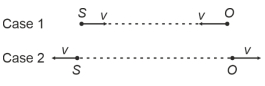
- 6A source $(S)$ of sound has frequency $240 \ Hz$. When the observer $(O)$ and the source move towards each other at a speed $v$ with respect to the ground (as shown in Case $1$ in the figure), the observer measures the frequency of the sound to be $288 \ Hz$. However, when the observer and the source move away from each other at the same speed $v$ with respect to the ground (as shown in Case $2$ in the figure), the observer measures the frequency of sound to be $n Hz$. The value of $n$ is. . . . . .View Solution
- 7The equation of a wave motion (with $t$ in seconds and $x$ in metres) is given by $y = 7\sin \,\left[ {7\pi t - 0.4\pi x + \frac{\pi }{3}} \right]$. The velocity of the wave will beView Solution
- 8An organ pipe filled with a gas at $27^{\circ}\,C$ resonates at $400\,Hz$ in its fundamental mode. If it is filled with the same gas at $90^{\circ}\,C$, the resonance frequency at the same mode will be $...........\,Hz$View Solution
- 9Equation of the progressive wave is given by : $y = a\sin \pi (40t - x)$ where $a$ and $x$ are in metre and $t$ in second. The velocity of the wave is ..... $m/s$View Solution
- 10A source of sound placed at the open end of a resonance column sends an acoustic wave of pressure amplitude ${\rho _0}$ inside the tube. If the atmospheric pressure is ${\rho _A},$ then the ratio of maximum and minimum pressure at the closed end of the tube will beView Solution