MCQ
If the length of second's pendulum is decreased by $2\%$, how many seconds it will lose per day ...... $\sec$
  • A
    $3927$
  • B
    $3727$
  • C
    $3427$
  • $864$

Answer

Correct option: D.
$864$
d
(d) $T \propto \sqrt l $

==> $\frac{{\Delta T}}{T} = \frac{1}{2}\frac{{\Delta l}}{l} = \frac{{0.02}}{2} = 0.01$

==>$\Delta T = 0.01\,T$

Loss of time per day $ = 0.01 \times 24 \times 60 \times 60$$ = 864\sec $

Need a full question paper?

Generate a complete, print-ready paper with questions like this in minutes — across 16+ boards, with answer keys.
Start Generating Free

Similar questions

A balloon starts rising from the ground with an acceleration of $1.25\ m/s^2.$ After $8$ seconds, a stone is released from the balloon. The stone will $($use $g = 10\ m/s^2):$
$Assertion$: A rigid disc rolls without slipping on a fixed rough horizontal surface with uniform angular velocity. Then the acceleration of lowest point on the disc is zero.
$Reason$ : For a rigid disc rolling without slipping on a fixed rough horizontal surface, the velocity of the lowest point on the disc is always zero
At atmospheric pressure, the water boils at $100°C$. If pressure is reduced, it will boil at
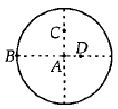
The moment of inertia of a uniform circular disc is maximum about an axis perpendicular to the disc and passing through
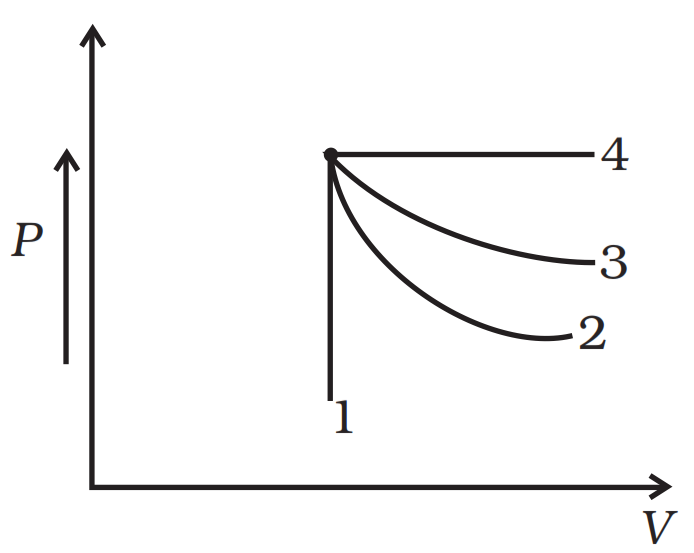
An ideal gas undergoes four different processes from thesame initial state $($Fig.$)$. Four processes are adiabatic, isothermal, isobaric and isochoric. Out of $1, 2, 3$ and $4$ whichone is adiabatic.
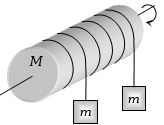
A uniform solid cylinder of mass $M$ and radius $R$ rotates about a frictionless horizontal axle. Two similar masses suspended with the help two ropes wrapped around the cylinder. If the angular velocity of the cylinder, after the masses fall down through distance $h$, will be
As the temperature is increased, the time period of a pendulum:
A rod of length $L$ has non-uniform linear mass density given by $\rho(\mathrm{x})=\mathrm{a}+\mathrm{b}\left(\frac{\mathrm{x}}{\mathrm{L}}\right)^{2},$ where $a$ and $\mathrm{b}$ are constants and $0 \leq \mathrm{x} \leq \mathrm{L}$. The value of $\mathrm{x}$ for the centre of mass of the rod is at
Two forces $\vec{F}_1$ and $\vec{F}_2$ are acting on a body. One force has magnitude thrice that of the other force and the resultant of the two forces is equal to the force of larger magnitude. The angle between $\vec{F}_1$ and $\overrightarrow{\mathrm{F}}_2$ is $\cos ^{-1}\left(\frac{1}{\mathrm{n}}\right)$. The value of $|\mathrm{n}|$ is__________.
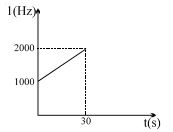
A detector is released from rest over a source of sound of frequency $f = 10^3 \,\,Hz$. The frequency observed by the detector at time $t$ is plotted in the graph. The speed of sound in air is $(g = 10 \,\,m/s^2)$ ... $m/s$