MCQ
If the linear momentum is increased by $50\%,$ then $K.E.$ will be increased by:
  • A
    $50\%$
  • B
    $100\%$
  • $125\%$
  • D
    $25\%$

Answer

Correct option: C.
$125\%$

Need a full question paper?

Generate a complete, print-ready paper with questions like this in minutes — across 16+ boards, with answer keys.
Start Generating Free

Similar questions

A magnetic field can be produced by:
Four uniform wires of the same material are stretched by the same force. The dimensions of wire are as given below. The one which has the minimum elongation has
A standing wave is represented by:
$
y=a \sin (100 t) \cos (0.01 x)
$
where y and a are in millimetre, t in second and x in metre. Velocity of wave is:
If the two ends of a p-n junction are joined by a wire:
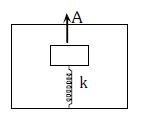
Inside a lift, a spring (Force constant $k = 1000\ N/m$) and block ($mass = 1\  kg$) are both in a state of rest. Now the lift suddenly starts moving upwards with acceleration $a = g$. Find the maximum total compression in the spring in centimeter. ($g =10\ m/s^2$) :-
Let us consider a system of units in which mass and angular momentum are dimensionless. If length has dimension of $L$, which of the following statement ($s$) is/are correct ?

$(1)$ The dimension of force is $L ^{-3}$

$(2)$ The dimension of energy is $L ^{-2}$

$(3)$ The dimension of power is $L ^{-5}$

$(4)$ The dimension of linear momentum is $L ^{-1}$
Four particles each of mass $m$ are placed at the vertices of a square of side $l.$ The potential energy of the system is
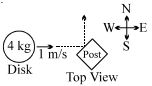
$A$ $4$ -kilogram disk slides over level ice toward the east at a velocity of $1$ meter per second, as shown. The disk strikes a post and rebounds toward the north at the same speed. The change in the magnitude of the eastward component of the momentum of the disk is ............. $\mathrm{kg}$ $ \cdot $ $\mathrm{m}/ \mathrm{s}$ 
A train has a speed of $60\, km/h$. for the first one hour and $40\, km/h $ for the next half hour. Its average speed in $km/h$ is
Young’s modulus of steel is $1.9 \times 10^{11} \ce{N/m^2}$. When expressed in $\ce{CGS}$ units of $\ce{dynes/cm^2}$, it will be equal to $\ce{(1N = 10^5 dyne, 1m^2 = 10^4cm^2)}$.