MCQ
If the metal bob of a simple pendulum is replaced by a wooden bob, then its time period will
  • A
    Increase
  • B
    Decrease
  • Remain the same
  • D
    First increase then decrease

Answer

Correct option: C.
Remain the same
c
(c)Remains the same because time period of simple pendulum T is independent of mass of the bob

Need a full question paper?

Generate a complete, print-ready paper with questions like this in minutes — across 16+ boards, with answer keys.
Start Generating Free

Similar questions

The dimensions of resistivity in terms of $M,\,L,\,T$ and $Q$ where $Q$ stands for the dimensions of charge, is
In a container having water filled upto a height $h,$ a hole is made in the bottom, the velocity of water following out of the hole is:
If $R$ and $L$ represent respectively resistance and self inductance, which of the following combinations has the dimensions of frequency
A sealed container with negligible coefficient of volumetric expansion contains helium (a monoatomic gas). When it is heated from $300\, K$ to $600\, K,$ the average $K.E.$ of helium atoms is
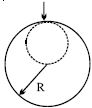
A spherical hole of radius $R/2$ is excavated from the asteroid of mass $M$ as shown in fig. The gravitational acceleration at a point on the surface of the asteroid just above the excavation is
Three photons coming from excited atomic-hydrogen sample are picked up. Their energies are 12.1eV, 10.2 eV and 1.9eV. These photons must come from:
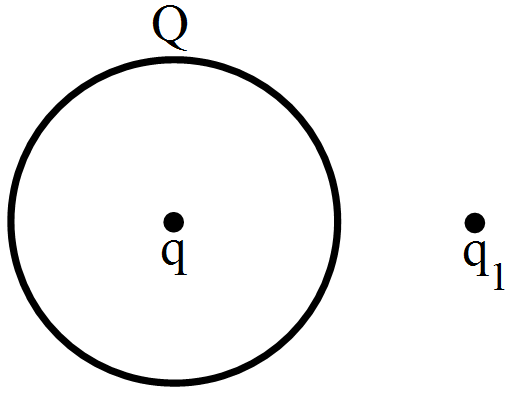
A thin, metallic spherical shell contains a charge $Q$ on it. A point charge $q$ is placed at the centre of the shell and another charge $q_1$ is placed outside it as shown in figure. All the three charges are positive. The force on the charge at the centre is:
 Match List $-I$ with List $-II$
  List $-I$   List $-II$
$A$. Coefficient of Viscosity $I$. $[M L^2T^{–2}]$
$B$. Surface Tension  $II$. $[M L^2T^{–1}]$
$C$. Angular momentum $III$. $[M L^{-1}T^{–1}]$
$D$. Rotational Kimeatic energy $IV$. $[M L^0T^{–2}]$
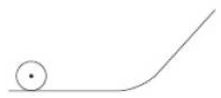
A solid sphere and solid cylinder of identical radii approach an incline with the same linear velocity (see figure). Both roll without slipping all throughout. The two climb maximum heights $h_{sph}$ and $h_{cyl}$ on the incline. The radio $\frac{{{h_{sph}}}}{{{h_{cyl}}}}$ is given by
A string of mass 2.5kg is under a tension of 200N. The length of the stretched string is 20.0m. If the transverse jerk is struck at one end of the string, the disturbance will reach the other end in: