MCQ
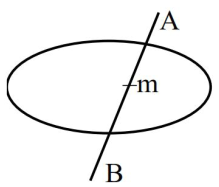
If the midpoint of a chord of the ellipse $\frac{x^2}{9}+\frac{y^2}{4}=1$ is $(\sqrt{2}, 4 / 3)$, and the length of the chord is $\frac{2 \sqrt{\alpha}}{3}$, then $\alpha$ is :
  • A
    18
  • B
    22
  • C
    26
  • D
    20

Answer

B.
Image
If $m \left(\sqrt{2}, \frac{4}{3}\right)$ than equation of of AB is
$T = S _1$
$\frac{x\sqrt{2}}{9}+\frac{y}{4}\left(\frac{4}{3}\right)=\frac{(\sqrt{2})^2}{9}+\frac{\left(\frac{4}{3}\right)^2}{4}$
$\frac{\sqrt{2} x}{9}+\frac{y}{3}=\frac{2}{9}+\frac{4}{9}$
$\sqrt{2} x+3 y=6 \Rightarrow y=\frac{6-\sqrt{2} x}{3}$ put in ellipse
So, $\frac{x^2}{9}+\frac{(6-\sqrt{2} x)^2}{9 \times 4}=1$
$4 x^2+36+2 x^2-12 \sqrt{2} x=36$
$6 x^2-12 \sqrt{2} x=0$
$6 x(x-2 \sqrt{2})=0$
$x=0 \& x=2 \sqrt{2}$
So $y=2 \quad y=\frac{2}{3}$
Length of chord $=\sqrt{(2 \sqrt{2}0)^2+\left(\frac{2}{3}2\right)^2}$
$=\sqrt{8+\frac{16}{9}}$
$=\sqrt{\frac{88}{9}}=\frac{2}{3} \sqrt{22}$ so $\alpha=22$

Need a full question paper?

Generate a complete, print-ready paper with questions like this in minutes — across 16+ boards, with answer keys.

Start Generating Free

Similar questions

If the given vectors $( - bc,\,{b^2} + bc,\,{c^2} + bc),$ $({a^2} + ac,\, - ac,\,{c^2} + ac)$ and $({a^2} + ab,\,{b^2} + ab,\, - ab)$ are coplanar, where none of  $a, b $ and $ c $ is zero, then
If the shortest distance between the lines

$ \mathrm{L}_1: \overrightarrow{\mathrm{r}}=(2+\lambda) \hat{\mathrm{i}}+(1-3 \lambda) \hat{\mathrm{j}}+(3+4 \lambda) \hat{\mathrm{k}}, \lambda \in \mathbb{R} $

$ \mathrm{L}_2: \overrightarrow{\mathrm{r}}=2(1+\mu) \hat{\mathrm{i}}+3(1+\mu) \hat{\mathrm{j}}+(5+\mu) \hat{k}, \mu \in \mathbb{R}$

is $\frac{\mathrm{m}}{\sqrt{\mathrm{n}}}$, where $\operatorname{gcd}(\mathrm{m}, \mathrm{n})=1$, then the value of $\mathrm{m}+\mathrm{n}$ equals.

Let $\vec{a}=6 \hat{ i }+\hat{ j }-\hat{ k }$ and $\vec{b}=\hat{ i }+\hat{ j }$. If $\overrightarrow{ c }$ is a is vector such that $|\vec{c}| \geq 6, \vec{a} \cdot \vec{c}=6|\vec{c}|,|\vec{c}-\vec{a}|=2 \sqrt{2}$ and the angle between $\vec{a} \times \vec{b}$ and $\vec{c}$ is $60^{\circ},$ then $|(\vec{a} \times \vec{b}) \times \vec{c}|$ is equal to :
Let $\alpha ,\beta$ be the roots of the quadratic equation ${x^2} + px + {p^3} = 0\,\,(p \ne 0)$. If $(\alpha ,\beta )$ is a point on the parabola ${y^2} = x,$ then the roots of the quadratic equation are
If the roots of the given equation $2{x^2} + 3(\lambda - 2)x + \lambda + 4 = 0$ be equal in magnitude but opposite in sign, then $\lambda $=
${n^{th}}$ term of the series $3.8 + 6.11 + $ $9.14 + 12.17 + .....$ will be
The sum of coefficients in the expansion of ${(x + 2y + 3z)^8}$ is
If $\sin \theta = \frac{{ - 4}}{5}$ and $\theta $ lies in the third quadrant, then $\cos \frac{\theta }{2} = $
The value of $\int \limits_{0}^{\pi} \frac{e^{\cos x} \sin x}{\left(1+\cos ^{2} x\right)\left(e^{\cos x}+e^{-\cos x}\right)} d x$ is equal to
The mean and variance of a random variable $X$ having a binomial distribution are $4$ and $2$ respectively, then $P(X = 1)$ is