Question
If the path difference between the slits $S_1$​ and $S_2​$ is $\lambda$, the central fringe will have an intensity of$:$

Answer

Path difference at the central fringe will be the same as the path difference at the slits i.e. $\lambda$.
Hence, the waves reaching the central fringe will be $180^\circ$ out of phase and will result in destructive interference.
Hence, the intensity of the central fringe will be $0.$

Need a full question paper?

Generate a complete, print-ready paper with questions like this in minutes — across 16+ boards, with answer keys.
Start Generating Free

Similar questions

A solid sphere and a hollow sphere of the same material and of equal radii are heated to the same temperature:
Assertion :   Gauss theorem is not applicable in magnetism.
Reason    : Mono magnetic pole does not exist.(a) If both assertion and reason are true and the reason is the correct explanation of the assertion.(b) If both assertion and reason are true but reason is not the correct explanation of the assertion.(c) If assertion is true but reason is false.(d) If the assertion and reason both are false.


A plane electromagnetic wave with a single frequency moves in vacuum in the positive x direction. Its amplitude is uniform over the yz plane its wavelength:
In an AC circuit, the impedance is 3​ times the reactance, then the phase angle is.
The magnetic flux linked with a circuit of resistance 100 ohm increases from 10 to 60 webers. The amount of induced charge that flows in the circuit is (in coulomb)(a) 0.5(b) 5(c) 50       (d) 100
       
The work function for metals A, B and C are respectively 1.92 eV, 2.0 eV and 5 eV. According to Einstein’s equation, the metals which will emit photo electrons for a radiation of wavelength 4100 Å is/are(a) None of these(b) A only(c) A and B only(d) All the three metals
       
From which layer of atmosphere are radiowaves reflected ?
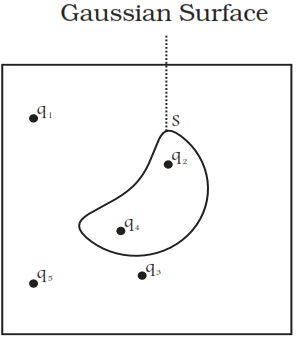
Five charges $q_1, q_2, q_3, q_4,$ and $q_5$ are fixed at their positions as shown in. $S$ is a Gaussian surface. The Gauss’s law is given by$\oint\limits_\text{S}\text{E.ds}=\frac{\text{q}}{\epsilon_0}$ Which of the following statements is correct?
A stream of electrons is projected horizontally to the right. A straight conductor carrying a current is supported parallel to the electron stream and above it. If the current in the conductor is from left to right, what will be the effect on the electron stream?
If a diamagnetic substance is brought near north or south pole of a bar magnet, it is: