If the period of oscillation of mass $m$ suspended from a spring is $2\, sec$, then the period of mass $4m$ will be .... $\sec$
AIIMS 1998, Medium
Download our app for free and get started
(d) $T = 2\pi \sqrt {\frac{m}{k}} $
==>$\frac{{{T_2}}}{{{T_1}}} = \sqrt {\frac{{{m_2}}}{{{m_1}}}} = \sqrt {\frac{{4m}}{m}} = 2$
$ \Rightarrow {T_2} = 2 \times 2 = 4\;s$

Download our appand get started for free
Experience the future of education. Simply download our apps or reach out to us for more information. Let's shape the future of learning together!No signup needed.*
Similar Questions
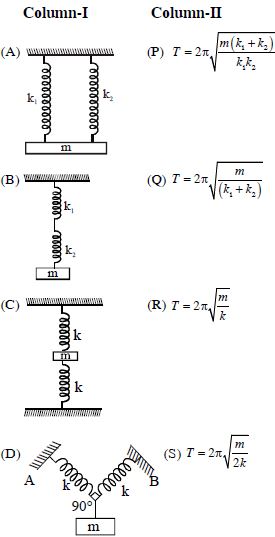
- 1In the following questions, match column $-I$ with column $-II$ and choose the correct optionsView Solution
- 2The vertical extension in a light spring by a weight of $1\, kg$ suspended from the wire is $9.8\, cm$. The period of oscillationView Solution
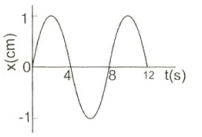
- 3The $x$-t graph of a particle undergoing simple harmonic motion is shown below. The acceleration of the particle at $t=4 / 3 \mathrm{~s}$ isView Solution
- 4A particle executes simple harmonic motion between $x =- A$ and $x =+ A$. If time taken by particle to go from $x=0$ to $\frac{A}{2}$ is $2 s$; then time taken by particle in going from $x =\frac{ A }{2}$ to $A$ is $.........\,s$View Solution
- 5An object of mass $0.2 \mathrm{~kg}$ executes simple harmonic motion along $\mathrm{x}$ axis with frequency of $\left(\frac{25}{\pi}\right) \mathrm{Hz}$. At the position $\mathrm{x}=0.04 \mathrm{~m}$ the object has kinetic energy $0.5 \mathrm{~J}$ and potential energy $0.4 \mathrm{~J}$ The amplitude of oscillation is ............ cm.View Solution
- 6The motion of a simple pendulum excuting $S.H.M$. is represented by following equation.View Solution
$Y = A \sin (\pi t +\phi)$, where time is measured in $second$.
The length of pendulum is .............$cm$
- 7$Assertion :$ In simple harmonic motion, the motion is to and fro and periodicView Solution
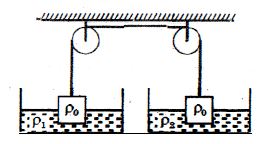
$Reason :$ Velocity of the particle $(v) = \omega \sqrt {k^2 - x^2}$ (where $x$ is the displacement). - 8Consider two identical cylinders [each of mass $m$ density $\rho _0$ horizontal cross-section area $s$] in equilibrium, partially submerged in two containers filled with liquids of densities $\rho_1$ and $\rho_2$ as shown in figure. Find the period of small oscillations of this system about its equilibrium. Neglect the changes in the level of liquids in the containers. Neglect mass of the strings. acceleration due to gravity is $g$ . ($v$ is volume of each block)View Solution
- 9A pendulum suspended from the ceiling of a train has a period $T$ when the train is at rest. When the train travels same distance per unit time, the period of oscillation isView Solution
- 10The period of oscillation of a simple pendulum of constant length at earth surface is $T$. Its period inside a mine isView Solution