MCQ
If the tension on a wire is removed at once, then
  • A
    It will break
  • B
    Its temperature will reduce
  • C
    There will be no change in its temperature
  • Its temperature increases

Answer

Correct option: D.
Its temperature increases
d
(d) Due to tension, intermolecular distance between atoms is increased and therefore potential energy of the wire is increased and with the removal of force interatomic distance is reduced and so is the potential energy.

This change in potential energy appears as heat in the wire and thereby increases the temperature.

Need a full question paper?

Generate a complete, print-ready paper with questions like this in minutes — across 16+ boards, with answer keys.
Start Generating Free

Similar questions

A light of wavelength $5890 \;\mathring A$ falls normally on a thin air film. The minimum thickness of the film such that the film appears dark in reflected light
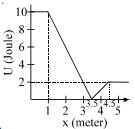
A body with mass $2\, kg$ moves in one direction in the presence of a force which is described by the potential energy graph. If the body is released from rest at $x = 2m$, then its speed when it crosses $x = 5\, m$ is ................ $\mathrm{m}/ \mathrm{s}$
Match List $- I$ (Experiment performed) with List $-II$ (Phenomena discovered/associated) and select the correct option from the options given the lists
List $- I$ List $- II$
$(1)$ Davisson and Genner $(i)$ Wave nature of electrons
$(2)$ Millikan's oil drop experiment $(ii)$ Charge of an electron
$(3)$ Rutherford experiment $(iii)$ Quantisation of energy levels
$(4)$ Franck-Hertz experiment $(iv)$ Existence of nucleus
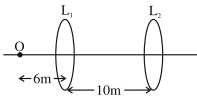
A point object, $O$ is placed in front of two thin symmetrical coaxial convex lenses $L _1$ and $L _2$ with focal length $24\,cm$ and $9\,cm$ respectively. The distance between two lenses is $10\,cm$ and the object is placed $6\,cm$ away from lens $L _1$ as shown in the figure. The distance between the object and the image formed by the system of two lenses is .........$cm$
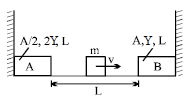
In the given figure, two elastic rods $A$ & $B$ are rigidly joined to end supports. $A$ small mass $‘m’$ is moving with velocity $v$ between the rods. All collisions are assumed to be elastic & the surface is given to be frictionless. The time period of small mass $‘m’$ will be : [$A=$ area of cross section, $Y =$ Young’s modulus, $L=$ length of each rod ; here, an elastic rod may be treated as a spring of spring constant $\frac{{YA}}{L}$ ]
Statement $-1$ : Ampere law can be used to find magnetic field due to finite length of a straight current carrying wire.

Statement $-2$ : The magnetic field due to finite length of a straight current carrying wire is symmetric about the wire.
A system consists of two identical spheres each of mass $1.5\, {kg}$ and radius $50\, {cm}$ at the end of light rod. The distance between the centres of the two spheres is $5\, {m}$. What will be the moment of inertia of the system about an axis perpendicular to the rod passing through its midpoint ? (in ${kgm}^{2}$)
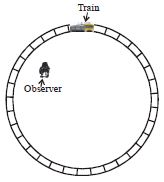
An engine is moving with uniform speed along a circular track emitting a sound of frequency $400\, Hz$ as shown in the figure. Speed of engine is $30\, m/sec$ and speed of sound is $330\, m/sec$. An observer is standing inside the track. Maximum frequency observed by the observer is
An electron beam passes through a magnetic field of $2 \times 10^{-3}\,Wb/m^2$ and an electric field of $1.0 \times 10^4\,V/m$ both acting simultaneously. The path of electron remains undeviated. The speed of electron if the electric field is removed, and the radius of electron path will be respectively
A man of weight $75\, kg$ is standing in an elevator which is moving with an acceleration of $5\,m/{s^2}$ in upward direction the apparent weight of the man will be  ........... $N$    $(g = 10\,\,m/{s^2})$