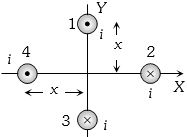
Statement $-1$ : Ampere law can be used to find magnetic field due to finite length of a straight current carrying wire.
Statement $-2$ : The magnetic field due to finite length of a straight current carrying wire is symmetric about the wire.
Medium


Download our appand get started for free
Experience the future of education. Simply download our apps or reach out to us for more information. Let's shape the future of learning together!No signup needed.*
Similar Questions
- 1Two long and parallel straight wires $A$ and $B$ carrying currents of $8.0\, A$ and $5.0\, A$ in the same direction are separated by a distance of $4.0\, cm$. Estimate the force on a $10\, cm$ section of wire $A$View Solution
- 2An electron is moving along positive $x$-axis. To get it moving on an anticlockwise circular path in $x-y$ plane, a magnetic filed is appliedView Solution
- 3The sensitivity of a galvanometer of resistance $406\, ohm$ is decreased by $30\, times$. The shunt used is .................. $\Omega$View Solution
- 4An $\alpha - $ particle travels in a circular path of radius $0.45\, m$ in a magnetic field $B = 1.2\,Wb/{m^2}$ with a speed of $2.6 \times {10^7}\,m/\sec $. The period of revolution of the $\alpha - $ particle isView Solution
- 5For a solenoid keeping the turn density constant its length is halved and its cross section radius is doubled then the inductance of the solenoid increased by.....$\%$View Solution
- 6A proton, a deuteron and an $\alpha-$particle with same kinetic energy enter into a uniform magnetic field at right angle to magnetic field. The ratio of the radii of their respective circular paths isView Solution
- 7Two charged particles, having same kinetic energy, are allowed to pass through a uniform magnetic field perpendicular to the direction of motion. If the ratio of radii of their circular paths is $6: 5$ and their respective masses ratio is $9: 4$. Then, the ratio of their charges will be.View Solution
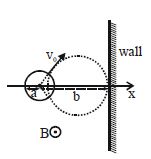
- 8An electron is projected normally from the surface of a sphere with speed $v_0$ in a uniform magnetic field perpendicular to the plane of the paper such that its strikes symmetrically opposite on the sphere with respect to the $x-$ axis. Radius of the sphere is $'a'$ and the distance of its centre from the wall is $'b'$ . What should be magnetic field such that the charge particle just escapes the wallView Solution
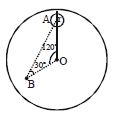
- 9The figure shows the cross section of a long cylindrical conductor through which an axial hole of radius $r$ is drilled with its centre at point $A$ . $O$ is the centre of the conductor. If an identical hole were to be drilled centred at point $B$ while maintaining the same current density the magnitude of magnetic field at $O$View Solution
- 10What will be the resultant magnetic field at origin due to four infinite length wires. If each wire produces magnetic field '$B$' at originView Solution