If the thermionic current density is $J$ and emitter temperature is $T$ then the curve between $\frac{J}{T^2}$ and $\frac{1}{T}$ will be
- A
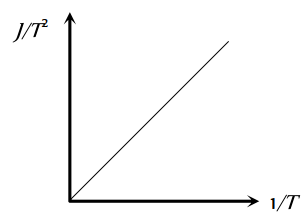
- B
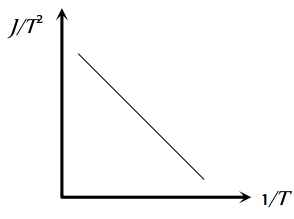
- C
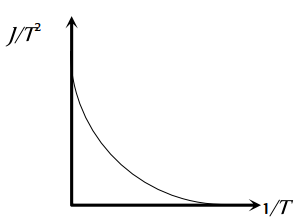
- D
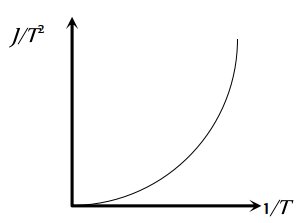


Download our appand get started for free
Experience the future of education. Simply download our apps or reach out to us for more information. Let's shape the future of learning together!No signup needed.*
Similar Questions
- 1No bias is applied to a $P-N$ junction, then the currentView Solution
- 2View SolutionDiode is used as a/an
- 3View SolutionAt ordinary temperatures, the electrical conductivity of semi conductors in mho/meter is in the range
- 4With a change of load resistance of a triode, used as an amplifier, from $50$ kilo ohms to $100$ kilo ohms, its voltage amplification changes from $25$ to $30.$ Plate resistance of the triode isView Solution
- 5If a full wave rectifier circuit is operating from $50 Hz$ mains, the fundamental frequency in the ripple will beView Solution
- 6View SolutionThe process of adding impurities to the pure semiconductor is called
- 7View SolutionGaAs is
- 8In the $C B$ mode of a transistor, when the collector voltage is changed by $0.5$ volt. The collector current changes by $0.05\ mA$. The output resistance will beView Solution
- 9A diode having potential difference $0.5 V$ across its junction which does not depend on current, is connected in series with resistance of $20 \Omega$ across source. If $0.1 A$ passes through resistance then what is the voltage of the sourceView Solution
- 10$14 \times 10^{15}$ electrons reach the anode per second. If the power consumed is 448 milliwatts, then the plate (anode) voltage isView Solution