MCQ
Work done by a system under isothermal change from a volume ${V_1}$ to ${V_2}$ for a gas which obeys Vander Waal's equation $(V - \beta n)\,\left( {P + \frac{{\alpha {n^2}}}{V}} \right) = nRT$
  • $nRT{\log _e}\left( {\frac{{{V_2} - n\beta }}{{{V_1} - n\beta }}} \right) + \alpha \,{n^2}\,\left( {\frac{{{V_1} - {V_2}}}{{{V_1}{V_2}}}} \right)$
  • B
    $nRT{\log _{10}}\left( {\frac{{{V_2} - \alpha \beta }}{{{V_1} - \alpha \beta }}} \right) + \alpha \,{n^2}\,\left( {\frac{{{V_1} - {V_2}}}{{{V_1}{V_2}}}} \right)$
  • C
    $nRT{\log _e}\left( {\frac{{{V_2} - n\alpha }}{{{V_1} - n\alpha }}} \right) + \beta \,{n^2}\,\left( {\frac{{{V_1} - {V_2}}}{{{V_1}{V_2}}}} \right)$
  • D
    $nRT{\log _e}\left( {\frac{{{V_1} - n\beta }}{{{V_2} - n\beta }}} \right) + \alpha \,{n^2}\,\left( {\frac{{{V_1}{V_2}}}{{{V_1} - {V_2}}}} \right)$
Answer

Correct option: A.
$nRT{\log _e}\left( {\frac{{{V_2} - n\beta }}{{{V_1} - n\beta }}} \right) + \alpha \,{n^2}\,\left( {\frac{{{V_1} - {V_2}}}{{{V_1}{V_2}}}} \right)$
a
(a)According to given Vander Waal’s equation
$P = \frac{{nRT}}{{V - n\beta }} - \frac{{\alpha {n^2}}}{{{V^2}}}$
Work done, $W = \int_{{V_1}}^{{V_2}} {PdV} = nRT\int_{{V_1}}^{{V_2}} {\frac{{dV}}{{V - n\beta }}} - \alpha {n^2}\int_{{V_1}}^{{V_2}} {\frac{{dV}}{{{V^2}}}} $
$ = nRT\,\left[ {{{\log }_e}(V - n\beta )} \right]\,_{{V_1}}^{{V_2}} + \alpha {n^2}\left[ {\frac{1}{V}} \right]_{{V_1}}^{{V_2}}$
$ = nRT{\log _e}\frac{{{V_2} - n\beta }}{{{V_1} - n\beta }} + \alpha {n^2}\left( {\frac{{{V_1} - {V_2}}}{{{V_1}{V_2}}}} \right)$

Need a full question paper?

Generate a complete, print-ready paper with questions like this in minutes — across 16+ boards, with answer keys.

Start Generating Free

Similar questions

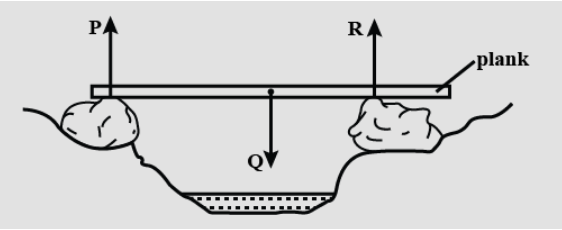
A wooden plank rests in equilibrium on two rocks on opposite sides of a narrow stream. Three forces $P, Q$ and $R$ act on the plank. How are the sizes of the forces related?
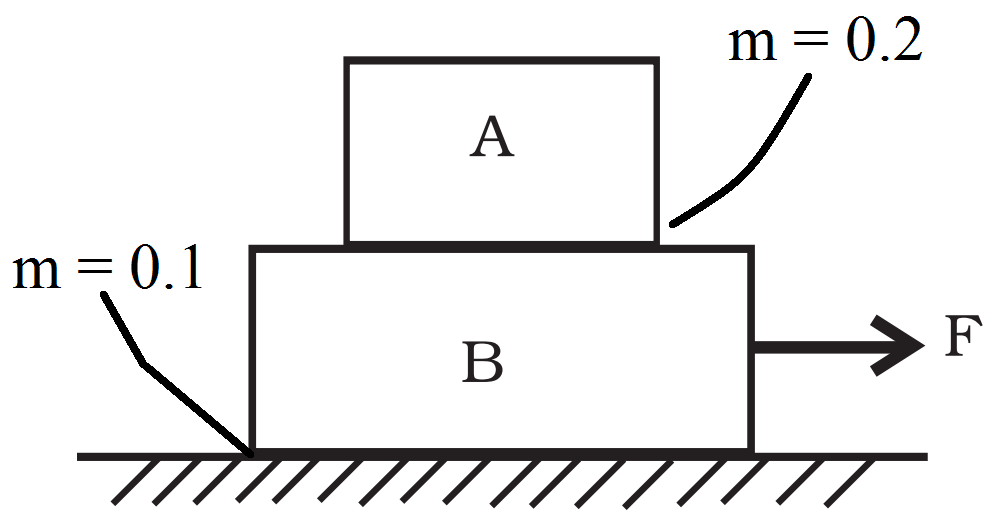
In the $co-$efficient of friction between the floor and the body $B$ is $0.1.$ The $co-$efficient of friction between the bodies $B$ and $A$ is $0.2. \ A$ force $F$ is applied as shown on $B.$ The mass of $A$ is $m^2$ and of $B$ is $m.$ Which of the following statements are true?
  1. a The bodies will move together if $F = 0.25\ mg.$
  2. The body $A$ will slip with respect to $B$ if $F = 0.5\ mg.$
  3. The bodies will be at rest if $F = 0.1\ mg.$
  4. The maximum value of $F$ for which the two bodies will move together is $0.45\ mg.$
Two periodic waves of amplitudes $A_1$ and $A_2$ pass through a region. If $A_1>A_2$, the difference in the maximum and minimum resultant amplitude possible is:
Two satellites of earth, $S_1$ and $S_2$ are moving in the same orbit. The mass of $S_1$ is four times the mass of $S_2.$ Which one of the following statements is true?
A metal bal of mass $0.1\, kg$ is heated upto $500\,{}^oC$ and dropped into a vessel of heat capacity $800\, JK^{-1}$ and containing $0.5\, kg$ water. The initial temperature of water and vessel is $30\,{}^oC$. ........ $\%$ is the approximate percentage increment in the temperature of the water. [Specific heat Capacities of water and metal are, respectively $4200\, Jkg^{-1}K^{-1}$ and $400\, Jkg^{-1}K^{-1}$]
A system consists of two types of gas molecules $A$ and $B$ having same number density $2 \times$ $10^{25}\, / {m}^{3}$. The diameter of ${A}$ and ${B}$ are $10\, \stackrel{\circ}{{A}}$ and $5\, \stackrel{\circ}{{A}}$ respectively. They suffer collision at room temperature. The ratio of average distance covererd by the molecule $A$ to that of $B$ between two successive collision is $.....\,\times 10^{-2}$
A block of mass $M$ slides down on a rough inclined plane with constant velocity. The angle made by the incline plane with horizontal is $\theta$. The magnitude of the contact force will be.
A particle is released from height $\mathrm{S}$ from the surface of the Earth. At a certain height its kinetic energy is three times its potential energy. The height from the surface of earth and the speed of the particle at that instant are respectively :
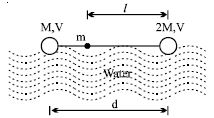
A dumbbell is placed in water of density $\rho$ . It is observed that by attaching a mass $m$ to the rod, the dumbbell floats with the rod horizontal on the surface of water and each sphere exactly half submerged as shown in the figure. The volume of the mass $m$ is negligible. The value of length $l$ is
The kinetic energy force on the particle continuously increases with time.