MCQ
If there is no external force acting on a nonrigid body, which of the following quantities must remain constant?
  • A
    Angular momentum.
  • B
    Linear momentum.
  • $A$ and $B$
  • D
    Moment of inertia.

Answer

Correct option: C.
$A$ and $B$

$\overrightarrow{\text{F}}_{\text{ext}}=0$
$\Rightarrow\overrightarrow{\tau}_{\text{ext}}=0$
That is, the change in linear momentum and angular momentum is zero. This is because:
$\frac{\text{d}\overrightarrow{\text{P}}}{\text{dt}}=\overrightarrow{\text{F}}_{\text{ext}}$
And $\frac{\text{d}\overrightarrow{\text{L}}}{\text{dt}}=\overrightarrow{\tau}_{\text{ext}}$

Need a full question paper?

Generate a complete, print-ready paper with questions like this in minutes — across 16+ boards, with answer keys.
Start Generating Free

Similar questions

$A$ solid sphere with a velocity (of centre of mass) $v$ and angular velocity $\omega$ is gently placed on a rough horizontal surface. The frictional force on the sphere:
The maximum and minimum tension in the string whirling in a circle of radius $2.5 \,m$ with constant velocity are in the ratio $5 : 3$ then its velocity is
The relation between two specific heats of a gas is
Which of the following is a vector
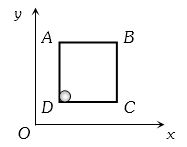
A solid sphere of mass $2\, kg$ is resting inside a cube as shown in the figure. The cube is moving with a velocity $v = (5t\,\hat i + 2t\,\hat j)m/s$. Here t is the time in second. All surface are smooth. The sphere is at rest with respect to the cube. ........... $N$  is the total force exerted by the sphere on the cube. (Take $g = 10\, m/s^2$)
A coin placed on a rotating table just slips if it is placed at a distance $4r$ from the centre. On doubling the angular velocity of the table, the coin will just slip when at a distance from the centre equal to
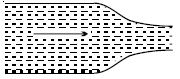
Water flows through a frictionless duct with a cross-section varying as shown in figure. Pressure $p$ at points along the axis is represented by
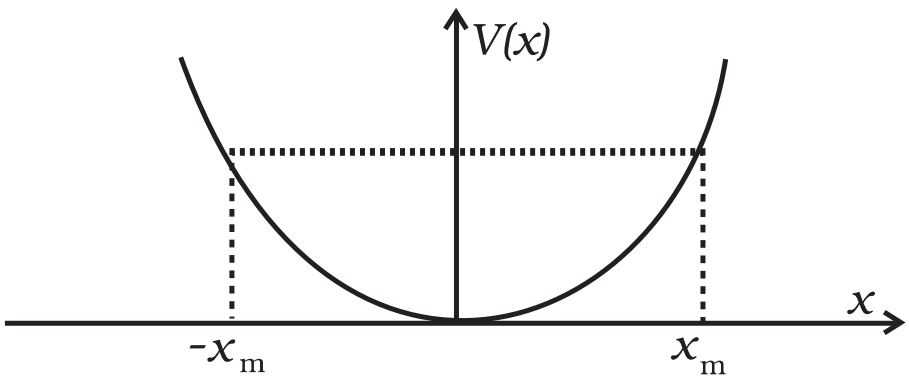
The potential energy function for a particle executing linear $\text{SHM}$ is given by $\text{v(x)}=\frac{1}{2}\text{kx}^2$ where $k$ is the force constant of the oscillator. For $k = 0.5N/ m,$ the graph of $V(x)$ versus $x$ is shown in the figure. A particle of total energy $E$ turns back when it reaches $\text{x}=\pm\text{x}_\text{m}.$ If $V$ and $K$ indicate the $P.E$. and $K.E.,$ respectively of the particle at $x = +xm,$ then which of the following is correct?
If the wave equation $y = 0.08\sin \frac{{2\pi }}{\lambda }(200t - x)$ then the velocity of the wave will be
A device used to measure very high temperature is