MCQ
If two compounds have the same empirical formula but different molecular formula, they must have
  • A
    Different percentage composition
  • Different molecular weights
  • C
    Same viscosity
  • D
    Same vapour density

Answer

Correct option: B.
Different molecular weights
b
If two compounds have the same empirical formula but different molecular formula, they must have different molecular weights.

For example, $CH _2 O$ and $C _6 H _{12} O _6$ have the same empirical formula but different molecular formula, they have different molecular weights.

Need a full question paper?

Generate a complete, print-ready paper with questions like this in minutes — across 16+ boards, with answer keys.

Start Generating Free

Similar questions

Second ionization potential of $Li, Be$ and $B$ is in the order
Which of the following metal does not react with water?
Element $"E"$ belongs to the period $4$ and group $16$ of the periodic table. The valence shell electron configuration of the element, which is just above $'E'$ in the group is $.....$
Given below are two statements:

Statement $I$: IUPAC name of $\mathrm{HO}-\mathrm{CH}_2-\left(\mathrm{CH}_2\right)_3-$ $\mathrm{CH}_2-\mathrm{COCH}_3$ is $7$-hydroxyheptan-2-one.

Statement $II$: $2$-oxoheptan-$7$-ol is the correct IUPAC name for above compound.In the light of the above statements. choose the most appropriate answer from the options given below:
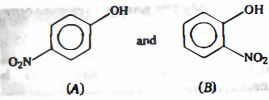
Out of the two compounds shown below, the vapour pressure of $B$ at a particular  temperature is expected to be
In a Lassaignes’s test for sulphur in the organic compound with sodium nitroprusside solution the purple colour formed is due to
Which of the following has no dipole moment
The size of the species, $Pb, Pb^{2+} , Pb^{4+}$ decreases as
For the reaction, $2 \mathrm{CO}+\mathrm{O}_2 \longrightarrow 2 \mathrm{CO}_2 ; \Delta \mathrm{H}=-560 \mathrm{~kJ}$. Two moles of $\mathrm{CO}$ and one mole of $\mathrm{O}_2$ are taken in a container of volume $1 \mathrm{~L}$. They completely form two moles of $\mathrm{CO}_2$, the gases deviate appreciably from ideal behaviour. If the pressure in the vessel changes from $70$ to $40 \mathrm{~atm}$, find the magnitude (absolute value) of $\Delta \mathrm{U}$ at $500 \mathrm{~K}$. $(1 \mathrm{~L} \mathrm{~atm}=0.1 \mathrm{~kJ})$
The incorrect postulates of the Dalton's atomic theory are :

$(A)$ Atoms of different elements differ in mass.

$(B)$ Matter consists of divisible atoms.

$(C)$ Compounds are formed when atoms of different element combine in a fixed ratio.

$(D)$ All the atoms of given element have different properties including mass.

$(E)$ Chemical reactions involve reorganisation of atoms.

Choose the correct answer from the options given below :