Question
If two or more resistances are connected in such a way that the same potential difference gets applied to each of them, then they are said to be connected in parallel.
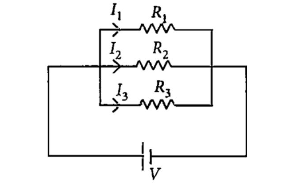
Image
The current flowing through the two resistances in parallel is, however, not the same. When we have two or more resistances joined in parallel to one another, then the same current gets additional paths to flow and the overall resistance decreases.
i. Three resistances, $2 \Omega, 6 \Omega$ and $8 \Omega$ are connected in parallel, then what will be the equivalent resistance?
ii. A wire of resistance $12 \Omega$ is cut into three equal pieces and then twisted their ends together, then what will be the equivalent resistance?
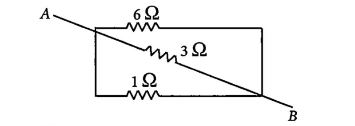
iii. Three resistances are connected as shown. Calculate the equivalent resistance between $A$ and $B$
Image
OR
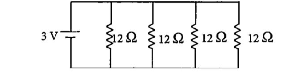
Find the current in each resistance.
Image

Answer

i. The equivalent resistance in the parallel combination is lesser than the least value of the individual resistance.The equivalent resistance of parallel combinations
$\frac{1}{R p}=\frac{1}{2}+\frac{1}{4}+\frac{1}{8}$
$\Rightarrow \mathrm{Rp}=\frac{8}{7} \Omega$
Thus equivalent resistance is less than $2 \Omega$.
ii. Resistance of each piece $=\frac{12}{3}=4 \Omega$
$\frac{1}{R_{p}}=\frac{1}{4}+\frac{1}{4}+\frac{1}{4}=\frac{3}{4} \Rightarrow R_{p}=\frac{4}{3} \Omega$
iii. All the three resistors are in paralle.
$\therefore \frac{1}{R_{p}}=\frac{1}{6}+\frac{1}{3}+\frac{1}{1}=\frac{1+2+6}{6}=\frac{9}{6} R_{P}=\frac{6}{9}=\frac{2}{3} \Omega$
OR
All are in parallel.
$\frac{1}{R_{p}}=\frac{1}{12} \times 4=\frac{1}{3} \Rightarrow R_{p}=3 \Omega$
$I=\frac{3}{3}=1 \mathrm{~A}$
So, current in each resistor $I^{\prime}=\frac{3}{12}=\frac{1}{4} \mathrm{~A}$

Need a full question paper?

Generate a complete, print-ready paper with questions like this in minutes — across 16+ boards, with answer keys.

Start Generating Free

Similar questions

Is there a relationship between the radius of curvature $R$, and focal length $f$, of a spherical mirror ? For spherical mirrors of small apertures, the radius of curvature is found to be equal to twice the focal length. We put this as $R=2 f$. This implies that the principal focus of a spherical mirror lies midway between the pole and centre of curvature.
(i) Write relation between radius of curvature and focal length.
(ii) For which type of mirrors above relation is verified?
(iii) What should be size of the aperture?
or
(iv) Where is the principle focus of a spherical mirror lies?
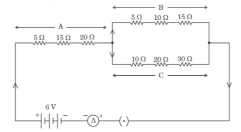
Leena creates an electric circuit with three resistors R1, R2 and R3.
Image
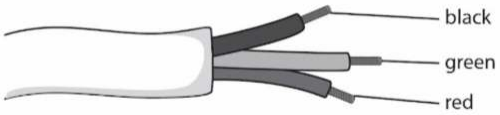
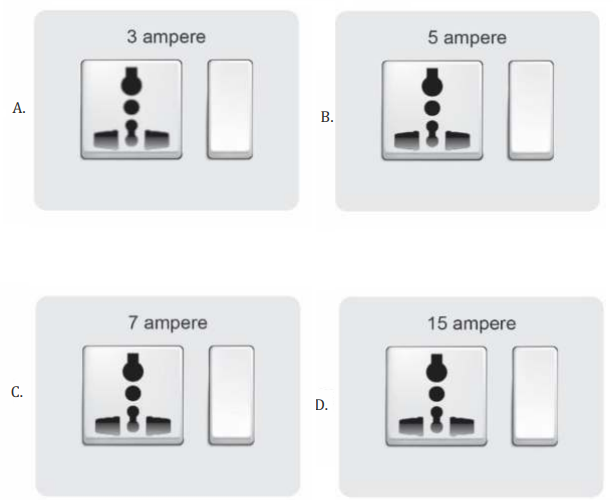
9. Which wire should be connected to the negative terminal of a socket?
Read the following and answer any three questions from (i) to (iv).

The heating effect of current is obtained by transformation of electrical energy in heat energy. Just as mechanical energy used to overcome friction is covered into heat, in the same way, electrical energy is converted into heat energy when an electric current flows through a resistance wire. The heat produced in a conductor, when a current flows through it is found to depend directly on (a) strength of current (b) resistance of the conductor (c) time for which the current flows. The mathematical expression is given by $\text{H} = \text{I}^2\text{Rt}.$

The electrical fuse, electrical heater, electric iron, electric geyser etc. all are based on the heating effect of current.

  1. What are the properties of heating element?

  2. What are the properties of electric fuse?

  3. When the current is doubled in a heating device and time is halved, the heat energy produced will be?
                                             OR
  4. A) A fuse wire melts at 5 A. It is is desired that the fuse wire of same material melt at 10 A. The new radius of the wire will be.

    B) When a current of 0.5A passes through a conductor for 5 min and the resistance of conductor is $10\Omega$ the amount of heat produced will be.
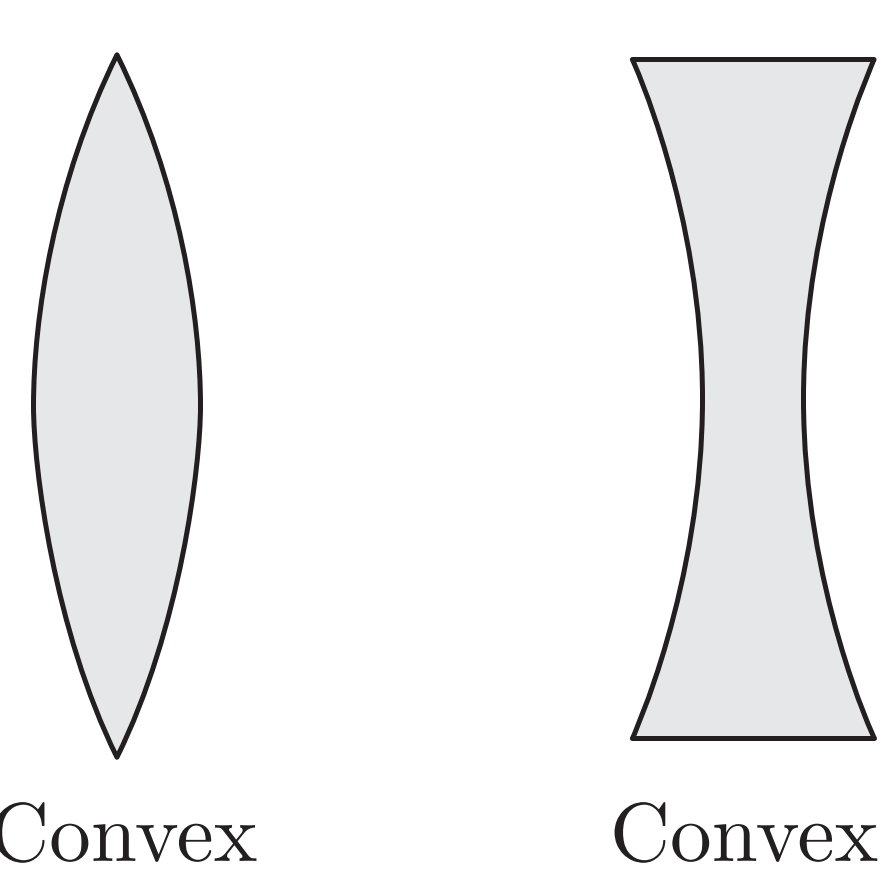
A concave lens is thick at the edges and thin at the centre, while a convex lens is thick at the centre and thin at the edges. We can distinguish between a concave lens and a convex lens without touching them. For this keep a book close to a lens and observe the image of the text of the book through the lens. If the letters appear enlarged, then it is a convex lens and if the letters appear diminished then it is a concave lens.

Convex lens converges light rays and hence known as converging lens. Similarly, concave lens diverges light rays and is known as diverging lens. Linear magnification produced by a lens is equal to the ratio of the image distance to the object distance. Power of a lens is defined as the reciprocal of its focal length.
(i) What type of image is always made by a concave lens?
(ii) If magnification produced by a spherical lens is $+0.75$, then what is the nature of the lens ?
(iii) What is the power of a convex lens with focal length $80 cm$ ?
or
(iii) What kind of lens is present in human eye?
Electrical devices often have an ampere marking to indicate the strength of electric current
required for it to work.
10. Will there be any change in the ammeter reading if the length of the wire in the circuit is doubled?
Explain your answer. 
Image
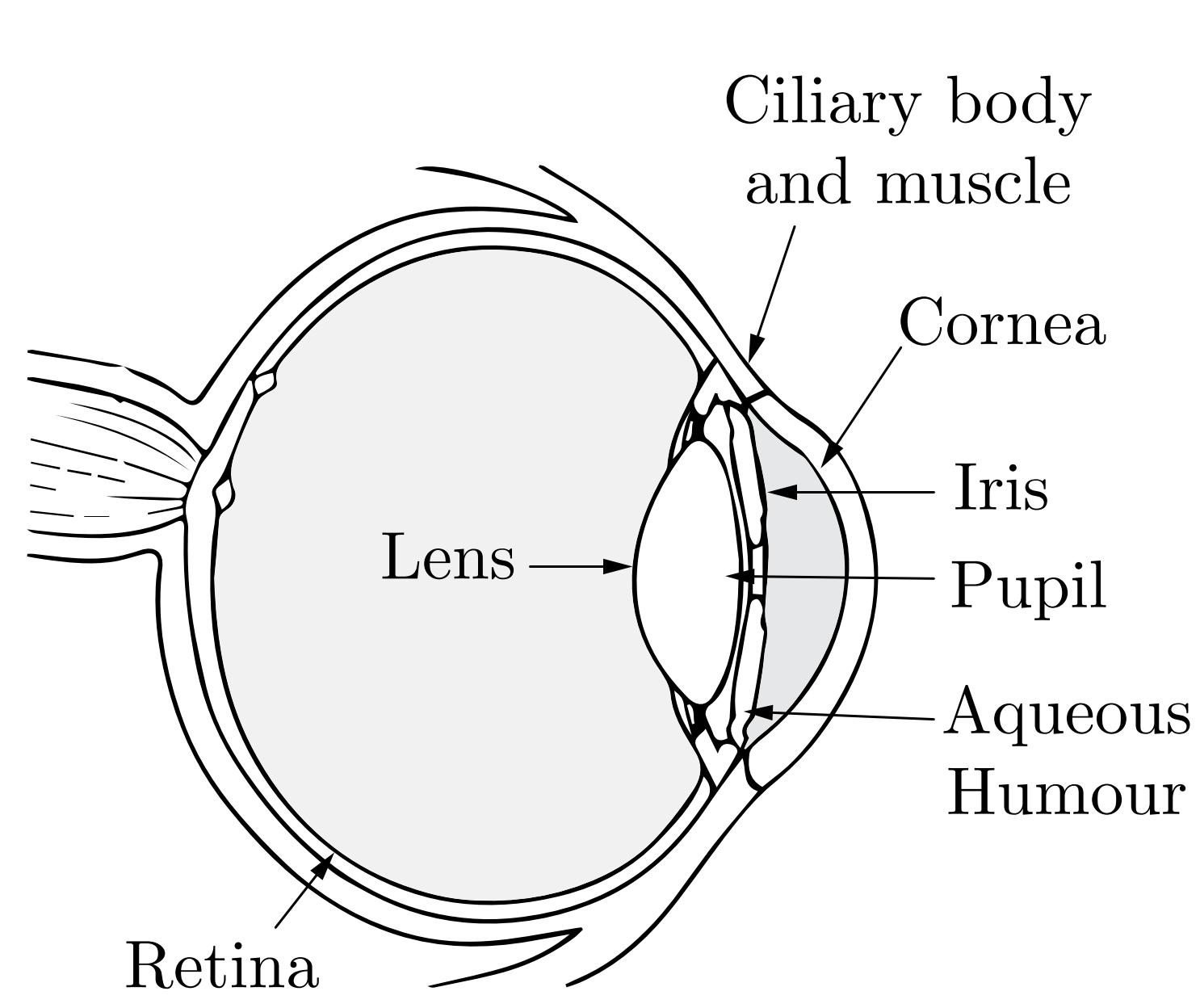
The ciliary muscle muscles of eye control the curvature of the lens in the eye and hence can alter the effective focal length of the system. When the muscles are fully relaxed, the focal length is maximum. When the muscles are strained the curvature of lens increases (that means radius of curvature decreases) and focal length decreases. For a clear vision the image must be on retina. The image distance is therefore fixed for clear vision and it equals the distance of retina from eye-lens. It is about $2.5 cm$ for a grown-up person. A person can theoretically have clear vision of objects situated at any large distance from the eye. The smallest distance at which a person can clearly see is related to minimum possible focal length, The ciliary muscles are most strained in this position. For an average grown-up person minimum distance of object should be around 25 cm. A person suffering for eye defects uses spectacles (Eye glass). The function of lens of spectacles is to form the image of the objects within the range in which person can see clearly. The image of the spectacle-lens becomes object for eye-lens and whose image is formed on retina. The number of spectacle-lens used for the remedy of eye defect is decided by the power of the lens required and the number of spectacle-lens is equal to the numerical value of the power of lens with sign. For example power of lens required is $+3 D$ (converging lens of focal length $100 / 3 cm$ ) then number of lens will be $+3$

For all the calculations required you can use the lens formula and lens maker's formula. Assume that the eye lens is equiconvex lens. Neglect the distance between eye lens and the spectacle lens.
(i) What do you mean by the ciliary muscles?
(ii) What is the minimum focal length of eye lens of a normal person ?
(iii) What is the maximum focal length of eye lens of normal person ?
or
(iv) A near-sighted man can clearly see object only up-to a distance of $100 cm$ and not beyond this. What is the number of the spectacles lens necessary for the remedy of this defect ?
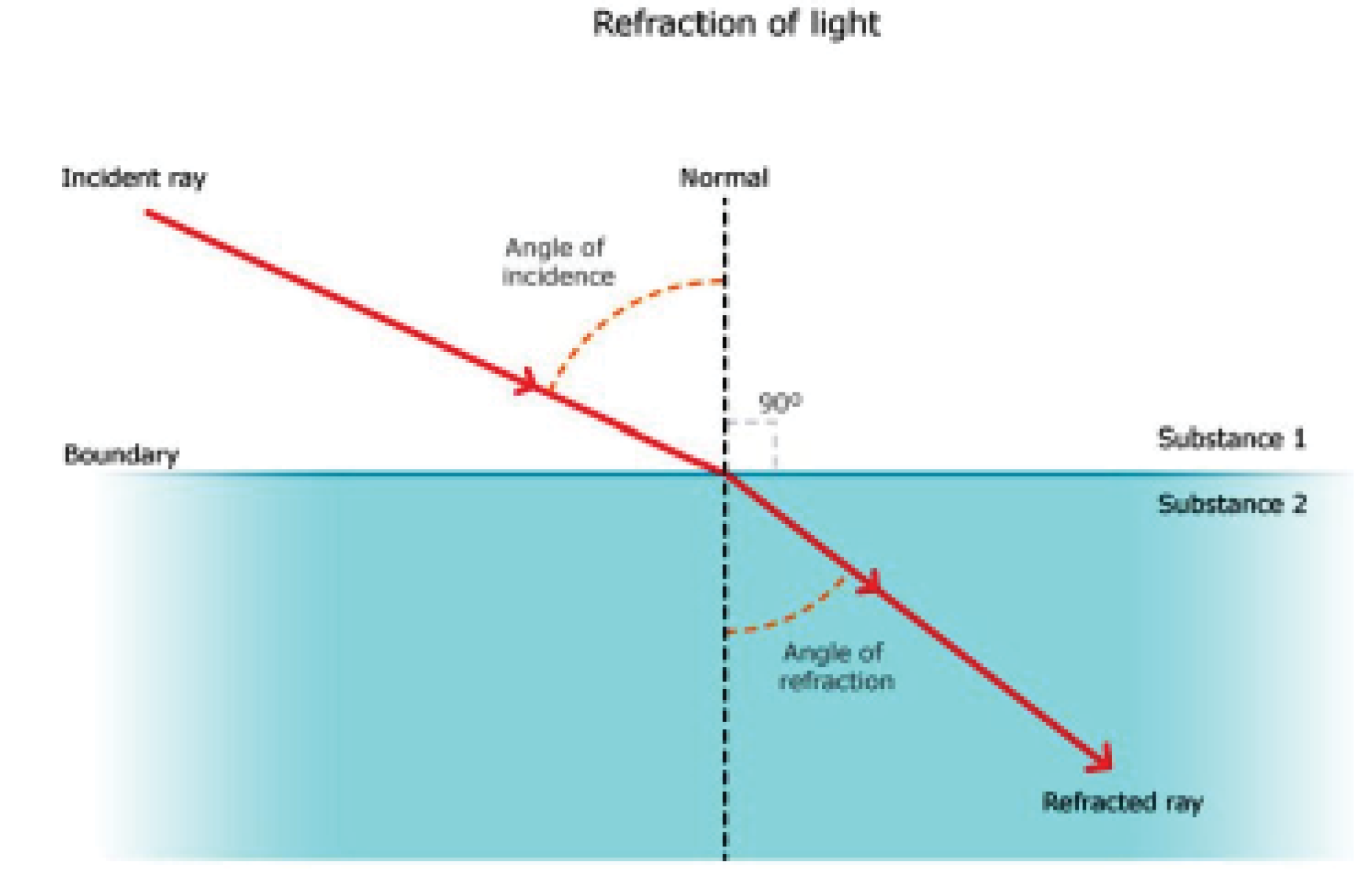
"Change in path of a light ray as it passes from one medium to another medium is called refraction of light."

When light travels from a rarer medium to a denser one, it bends towards the normal $(i>r)$ and when travels from a denser medium to a rarer one. it bends away from the normal $(iWhere, $\quad i=$ Angle of incidence
and $\quad r=$ Angle of refraction
We can see refraction in our daily life, some of the examples are given below :
The bottom of a tank or pond containing water appears to be raised due to refraction of light which takes place when light rays pass from the pool of water into the air. The letters appear to be raised when viewed through a glass slab placed over the document because of refraction of light.
When a light ray enters in a glass slab, then the emergent ray is parallel to the incident ray but it is shifted sideward slightly.
In this case, refraction takes place twice, first when ray enters glass slab from air and second when exits from glass slab to air.
(i) What do you mean by optically rarer and denser medium ?
(ii) What is the cause of refraction?
(iii) Draw a ray diagram shotving refraction through a glass slab.
or
(iv) Give one example of refraction from our daily life experience other than the two examples given above.