Answer

9. Yes
    No
    Yes
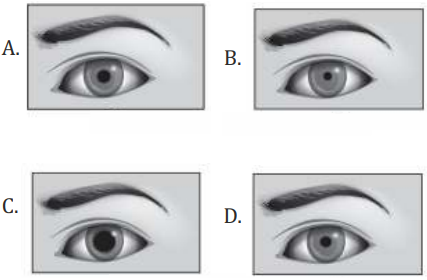
10. Mentions that the leaves absorb all colours and relect only the green colour to the eyes 

Need a full question paper?

Generate a complete, print-ready paper with questions like this in minutes — across 16+ boards, with answer keys.

Start Generating Free

Similar questions

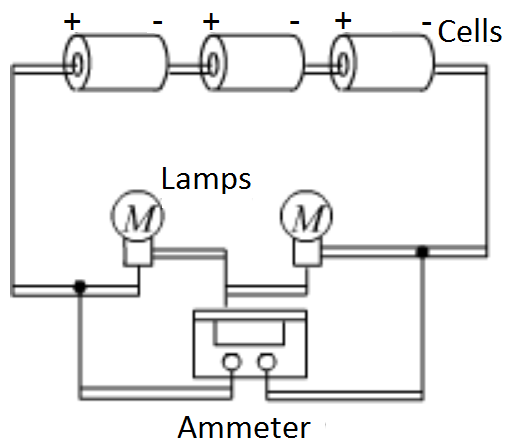
A student made an electric circuit shown here to measure the current through two lamps.
  1. Are the lamps in series or parallel?
  2. The student has made a mistake in this circuit. What is the mistake?
  3. Draw a circuit diagram to show the correct way to connect the circuit. Use the proper circuit symbols in your diagram.

Two or more resistances are connected in series or in parallel or both, depending upon whether we want to increase or decrease the circuit resistance.
Image
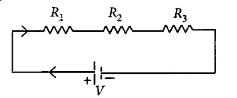
The two or more resistances are said to be connected in series if the current flowing through each resistor is the same.
i. When the three resistors each of resistance R ohm are connected in series then what will be the equivalent resistance?
ii. There is a wire of length 20 cm and having resistance $20 \Omega$ cut into 4 equal pieces and then joined in series. What is equivalent resistance?
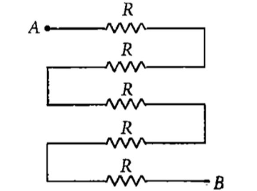
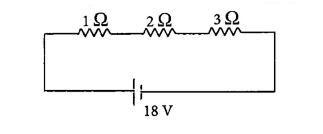
iii. In the following circuit, find the equivalent resistance between A and $\mathrm{B}(\mathrm{R}=2 \Omega)$
Image
OR
In the given circuit, what is the current in each resistor?
Image
Read the following and answer any three questions from (i) to (iv).

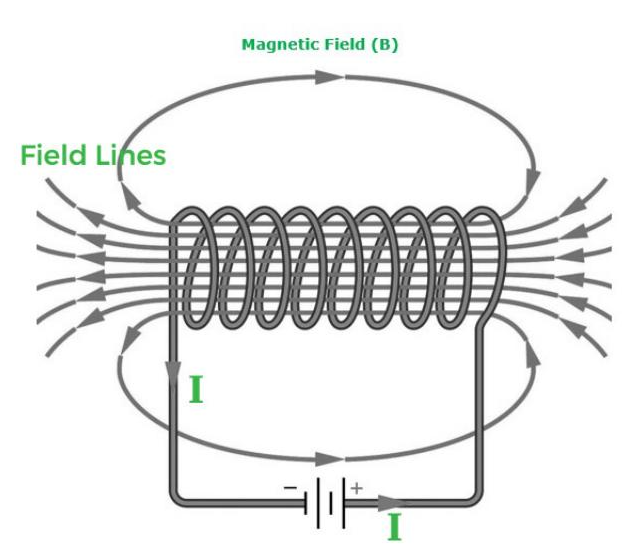
An insulated copper wire wound on a cylindrical cardboard tube such that its length is greater than its diameter is called a solenoid. When an electric current is passed through the solenoid, it produces a magnetic field around it. The magnetic field produced by a current-carrying solenoid is similar to the magnetic field produced by a bar magnet. The field tines inside the solenoid are in the form of parallel straight tines. The strong magnetic field produced inside a current-carrying solenoid can be used to magnetise a piece of magnetic material, like soft iron, when placed inside the solenoid. The strength of magnetic field produced by a current carrying solenoid is directly proportional to the number of turns and strength of current in the solenoid.

  1. The strength of magnetic field inside a long current-carrying straight solenoid is called?

  2. The north-south polarities of an electromagnet can be found easily by using which rule?

  3. Define a solenoid?

  4. A long solenoid carrying a current produces a magnetic field B along its axis. If the current is double and the number of turns per cm is halved, then new value of magnetic field will be?
An insulated copper wire wound on a cylindrical cardboard tube such that its length is greater than its diameter is called a solenoid. When an electric current is passed through the solenoid, it produces a magnetic field around it. The magnetic field produced by a current-carrying solenoid is similar to the magnetic field produced by a bar magnet. The field lines inside the solenoid are in the form of parallel straight lines. The strong magnetic field produced inside a current-carrying solenoid can be used to magnetize a piece of a magnetic material like soft iron when placed inside the solenoid. The strength of the magnetic field produced by a current-carrying solenoid is directly proportional to the number of turns and strength of the current in the solenoid.
Image
i. What would be the strength of the magnetic field inside a long current-carrying straight solenoid?
ii. Which end is north and which end is south pole when current flows through a solenoid?
iii. A long solenoid carrying a current produces a magnetic field B along its axis. If the current is double and the number of turns per cm is halved, then what will be the new value of the magnetic field?
OR
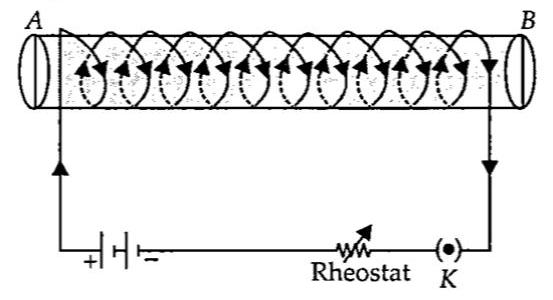
A soft iron bar is enclosed by a coil of insulated copper wire as shown in the figure. When the plug of the key is closed, then where would the face B of the iron bar be marked?
Image
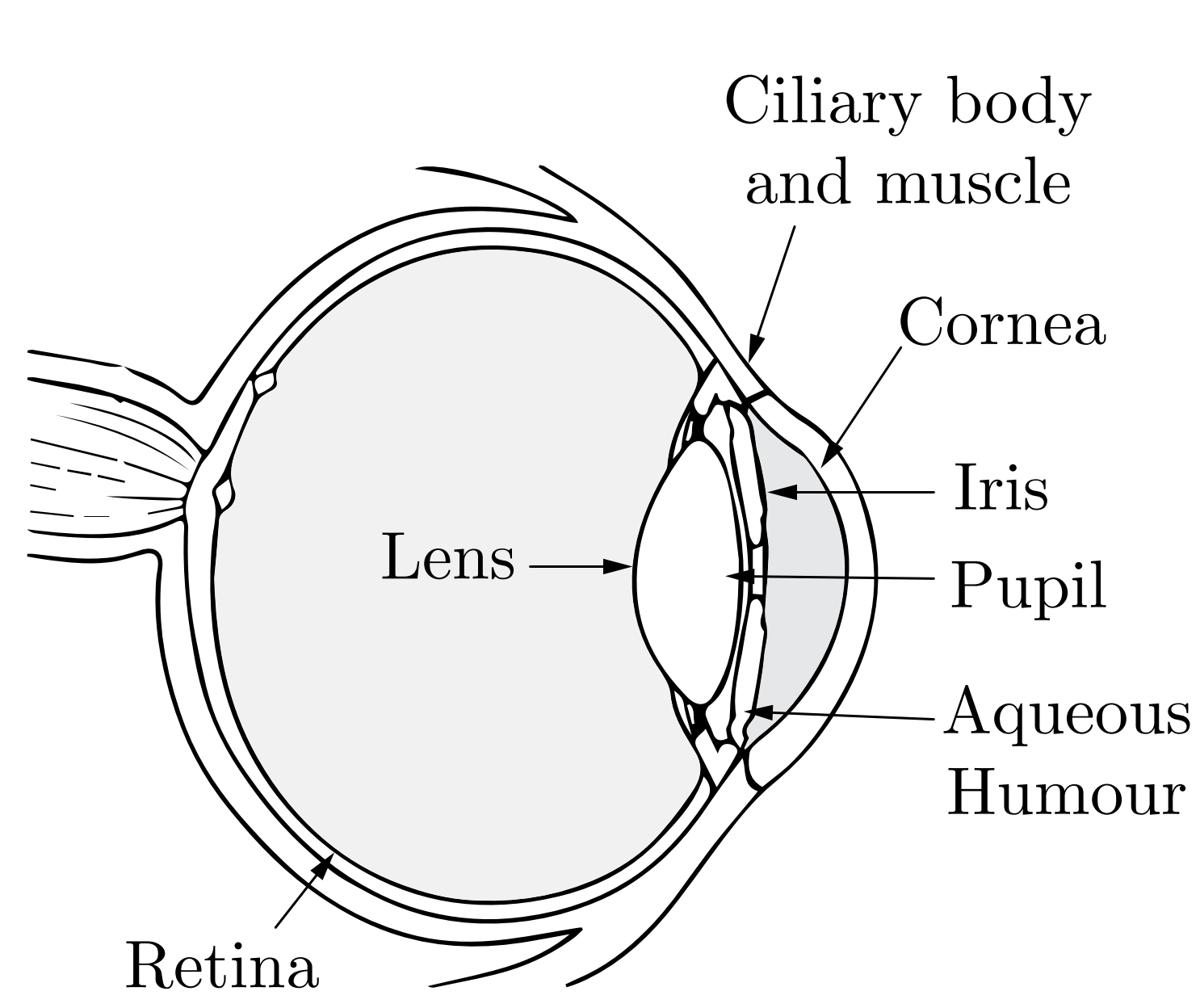
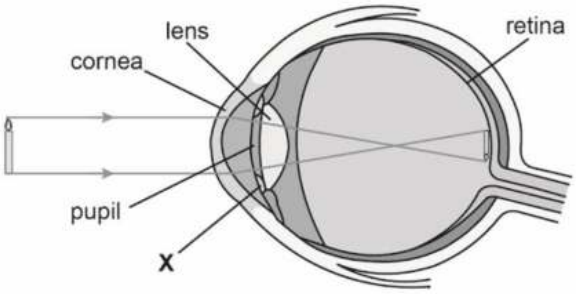
The lens of the eye does little of the bending of the light rays. Most of the refraction is done at the front surface of the cornea which also acts as a protective covering. The lens acts as a fine adjustment for focussing at different distances. This is accomplished by the ciliary muscle, which change the curvature of the lens so that its focal length is changed. To focus on a distant object, the muscles are relaxed and the lens is thin and parallel rays focus at the focal point (on the retina). To focus on a nearby object, the muscles contract, causing the centre of the lens to be thicker, thus shortening the focal length so that images of nearby objects can be focused on the retina, behind the focal point. This focusing adjustment is called accommodation.
The closest distance at which the eye can focus clearly is called the near point of the eye. A given person's far point is the farthest distance at which an object can be seen clearly. To check your own near point, place this book close to your eye and slowly move it away until the type is sharp.
A large part of the population have eyes that do not accommodate within the normal range of $25 cm$ to infinity, or have some other defect. Two common defects are near-sightedness and far-sightedness. Both can be corrected to a large extent with lenses-either eyeglasses or contact lenses.
(i) The ciliary muscle muscles of a normal eye are in their (i). most relaxed (ii). most contracted state. In which of the two cases is the focal length of the eye-lens more?
(ii) What is the least distinct of vision of young man?
(iii) What is persistence of vision?
or
(iv) What is meant by power of accommodation of the eye?
In 1827, a German physicist Georg Simon Ohm (1787-1854) found out the relationship between the current I, flowing in metallic wire and the potential difference across its terminals. He stated that the electric current flowing through a metallic wire is directly proportional to the potential difference V, across its ends provided its temperature remains the same.
The resistance of a circuit is defined as the ratio between the voltage applied to the current flowing through it. Rearranging the above relation,
$R=\frac{V}{I}$
Electric charge flows easily through some materials than others. The electrical resistance measures how much the flow of this electric charge is restricted within the circuit.
Image
i. What is the unit of electrical resistance?
ii. Define Ohm's law.
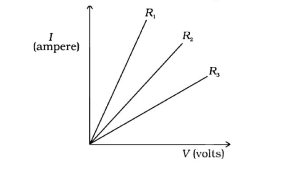
iii. From graph which resistance have high resistance?
OR
What does the slope of V-I graph at any point represent?
Mr. Rakesh was helping her daughter Aruna at home understanding about the basics of reflection of light. He found the simplest way to convey the role of curved mirrors using stainless steel teaspoon. Aruna got surprised to know that virtual image is that which can be seen but cannot be obtained on the screen. Mr. Rakesh then explained the formation of image using Ray diagrams.
(i) What do you mean by reflection of light?
(ii) The angle between incident ray and reflected ray is $60^{\circ}$. What is the value of angle of incidence?
(iii) A ray of light is incident on a plane mirror at an angle of $30^{\circ}$. what is the angle of reflection?
or
(iv) What happens to a light ray that is incident normally on a surface?
A concave mirror forms image of an object thrice in its size on a screen. Magnification of a mirror gives information about the size of the image relative to the object. It is defined as the ratio of size of image to the size of object. It is represented by $m$.
\[
m=\frac{\text { Size of image }}{\text { Size of object }}
\]
Sign of magnification by mirror gives the information about the nature of the image produce by it.
(i) Describe the nature of image formed.
(ii) If the object $x$ distance from the pole of mirror, then find image distance from the pole.
(iii) If the radius of curvature of mirror is $R$, then write the relation between object distance, image distance and focal length of the mirror.
or
(iv) Give one use of concave mirror.