MCQ
If two waves of same frequency and same amplitude respectively, on superimposition produced a resultant disturbance of the same amplitude, the waves differ in phase by
  • A
    $\pi$
  • $2 \pi / 3$
  • C
    $\pi / 2$
  • D
    Zero

Answer

Correct option: B.
$2 \pi / 3$
(b) $A^2=a^2=a^2+a^2+2 a^2 \cos \theta \Rightarrow \cos \theta=-\frac{1}{2} \Rightarrow \theta=\frac{2 \pi}{3}$

Need a full question paper?

Generate a complete, print-ready paper with questions like this in minutes — across 16+ boards, with answer keys.
Start Generating Free

Similar questions

A transparent cube of $15 \mathrm{~cm}$ edge contains a small air bubble. Its apparent depth when viewed through one face is $6 \mathrm{~cm}$ and when viewed through the opposite face is $4 \mathrm{~cm}$. Then the refractive index of the material of the cube is
A particle executing simple harmonic motion with amplitude of $0.1 m$. At a certain instant when its displacement is $0.02 m$, its acceleration is 0.5 $m / s$. The maximum velocity of the particle is (in $m / s$ )
A fish looking up through the water sees the outside world contained in a circular horizon. If the refractive index of water is $\frac{4}{3}$ and the fish is $12 \mathrm{~cm}$ below the surface, the radius of this circle in $\mathrm{cm}$ is
A body of length $1 \mathrm{~m}$ having cross sectional area $0.75 \mathrm{~m}$ has heat flow through it at the rate of $6000 \mathrm{Joule} / \mathrm{sec}$. Then find the temperature difference if $K=200 \mathrm{Jm}^{-1} K^{-1}$
Match List-l with List-ll and select the correct answer using the codes given below the lists
List-1 List-ll
I. Joule A. Henry $\times$ Amp/sec
II. Watt B. Farad $\times$ Volt
III. Volt C. Coulomb $\times$ Volt
IV. Coulomb D. Oersted $\times cm$
E. Amp $\times$ Gauss
F. $A m p^2 \times Ohm$
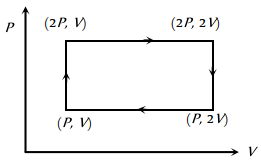
Work done in the given $P$ - $V$ diagram in the cyclic process is
Image
Dispersion of light is due to
A force of $5 N$, making an angle $\theta$ with the horizontal, acting on an object displaces it by $0.4 \mathrm{~m}$ along the horizontal direction. If the object gains kinetic energy of $1,$ the horizontal component of the force is
A glass flask is filled up to a mark with $50 c c$ of mercury at $18^{\circ} \mathrm{C}$. If the flask and contents are heated to $38^{\circ} \mathrm{C}$, how much mercury will be above the mark ? ( $\alpha$ for glass is $9 \times 10 \%{ }^{\circ} \mathrm{C}$ and coefficient of real expansion of mercury is $180 \times 10 \%{ }^{\circ} \mathrm{C}$ )
A body is imparted motion from rest to move in a straight line. If it is then obstructed by an opposite force, then