If ${u_1}$ and ${u_2}$ are the units selected in two systems of measurement and ${n_1}$ and ${n_2}$ their numerical values, then
Medium


Download our appand get started for free
Experience the future of education. Simply download our apps or reach out to us for more information. Let's shape the future of learning together!No signup needed.*
Similar Questions
- 1View SolutionThe unit of "impulse per unit area" is same as that of
- 2There are $100$ divisions on the circular scale of a screw gauge of pitch $1 \mathrm{~mm}$. With no measuring quantity in between the jaws, the zero of the circular scale lies $5$ divisions below the reference line. The diameter of a wire is then measured using this screw gauge. It is found the $4$ linear scale divisions are clearly visible while $60$ divisions on circular scale coincide with the reference line. The diameter of the wire is :View Solution
- 3The random error in the arithmetic mean of $100$ observations is $x$; then random error in the arithmetic mean of $400$ observations would beView Solution
- 4If $L,\,C$ and $R$ represent inductance, capacitance and resistance respectively, then which of the following does not represent dimensions of frequencyView Solution
- 5$SI$ unit of pressure isView Solution
- 6The dimensions of the product $\mu_{0} \varepsilon_{0}$ are related to those of velocity asView Solution
- 7Position of a body with acceleration '$a$' is given by $x = K{a^m}{t^n},$ here $t$ is time. Find dimension of $m$ and $n$.View Solution
- 8A screw gauge of pitch $0.5\,mm$ is used to measure the diameter of uniform wire of length $6.8\,cm$, the main scale reading is $1.5\,mm$ and circular scale reading is $7$. The calculated curved surface area of wire to appropriate significant figures is $......cm^2$ . [Screw gauge has $50$ divisions on the circular scale]View Solution
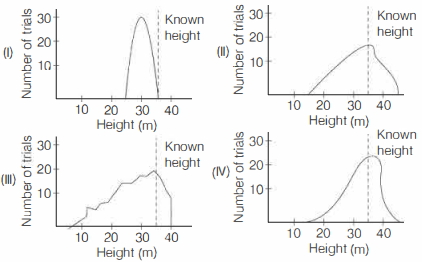
- 9View SolutionFour students measure the height of a tower. Each student uses a different method and each measures the height many different times. The data for each are plotted below. The measurement with highest precision is
- 10A student performs an experiment to determine the Young's modulus of a wire, exactly $2 \mathrm{~m}$ long, by Searle's method. In a particular reading, the student measures the extension in the length of the wire to be $0.8 \mathrm{~mm}$ with an uncertainty of $\pm 0.05 \mathrm{~mm}$ at a load of exactly $1.0 \mathrm{~kg}$. The student also measures the diameter of the wire to be $0.4 \mathrm{~mm}$ with an uncertainty of $\pm 0.01 \mathrm{~mm}$. Take $g=9.8 \mathrm{~m} / \mathrm{s}^2$ (exact). The Young's modulus obtained from the reading isView Solution