MCQ
If $\varepsilon_0$ is permittivity of free space, $e$ is charge of proton, $G$ is universal gravitational constant and $m_p$ is mass of a proton then the dimensional formula for $\frac{e^2}{4 \pi \varepsilon_0 G m_p{ }^2}$ is
  • A
    $\left[ M ^1 L ^1 T ^{-3} A ^{-1}\right]$
  • $\left[ M ^0 L ^0 T ^0 A ^0\right]$
  • C
    $\left[ M ^1 L ^3 T ^{-3} A ^{-1}\right]$
  • D
    $\left[ M ^{-1} L ^{-3} T ^4 A ^2\right]$
Answer

Correct option: B.
$\left[ M ^0 L ^0 T ^0 A ^0\right]$
b
(b)

Gravitational force $F_1=\frac{G M_P^2}{r^2}$

Electrostatic force $F_2=\frac{1}{4 \pi \varepsilon_0} \frac{e^2}{r^2}$

$\frac{F_2}{F_1}=\frac{e^2}{4 \pi \varepsilon_0 G M_\rho^2}$

$\therefore$ Dimension less $\left[ M ^{\circ} L ^{\circ} T ^{\circ} A ^{\circ}\right]$

Need a full question paper?

Generate a complete, print-ready paper with questions like this in minutes — across 16+ boards, with answer keys.

Start Generating Free

Similar questions

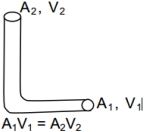
A liquid enter at point $A_{1}$ with speed $3.5 m / s$ and leaves at point $A _{2} .$ Then find out the height attained by the liquid above point $A _{2}$ (in $cm$)
A particle is moving in a straight line with initial velocity and uniform acceleration $a$. If the sum of the distance travelled in $t^{\text {th }}$ and $( t +1)^{ th }$ seconds is $100 cm$, then its velocity after $t$ seconds, in $.........cm / s$, is
The bob of a simple pendulum is of mass $10\, gm$. It is suspended with a thread of $1\, m$. If we hold the bob so as to stretch the string horizontally and release it. What will be the tension at the lowest position   ......... $N$
What is kinetic energy?
Column $I$ Contains a list of processes involving expansion of an ideal gas. Match this with Column $II$ describing the thermodynamic change during this process. Indicate your answer by darkening the appropriate bubbles of the $4 \times 4$ matrix given in the $ORS$.
Column $I$ Column $II$
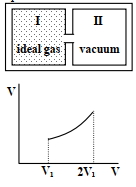
$(A)$ An insulated container has two chambers separated by a valve. Chamber $I$ contains an ideal gas and the Chamber $II$ has vacuum. The valve is opened. $(p)$ The temperature of the gas decreases
$(B)$ An ideal monoatomic gas expands to twice its original volume such that its pressure $\mathrm{P} \propto \frac{1}{\mathrm{~V}^2}$, where $\mathrm{V}$ is the volume of the gas $(q)$ The temperature of the gas increases or remains constant
$(C)$ An ideal monoatomic gas expands to twice its original volume such that its pressure $\mathrm{P} \propto \frac{1}{\mathrm{~V}^{4 / 3}}$, where $\mathrm{V}$ is its volume $(r)$ The gas loses heat
$(D)$ An ideal monoatomic gas expands such that its pressure $\mathrm{P}$ and volume $\mathrm{V}$ follows the behaviour shown in the graph $Image$ $(s)$ The gas gains heat

A $10\, cm$ long wire is placed horizontally on the surface of water and is gently pulled up with a force of $2 ×10^{-2}\,N$ to keep the wire in equilibrium. The surface tension, in $Nm^{-1}$, of water is
Three identical bodies of equal mass $M$ each are moving along a circle of radius $R$ under the action of their mutual gravitational attraction. The speed of each body is
The pressure exerted by the gas on the walls of the container because
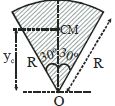
Sector of a circular plate shown in figure has position of centre of mass at $y_{CM} =$
The displacement of the wave given by equation $\text{y (x, t)}=\text{a}\sin(\text{kx}-\omega\text{t}+\phi),$ where $\phi = 0$ at point $x$ and $t = 0$ is same as that at point: