Question
If $\vec{\text{a}},\vec{\text{b}},\vec{\text{c}}$ are non-zero, non-coplanar vectors, prove that the vector is coplanar:
$5\vec{\text{a}}+6\vec{\text{b}}+7\vec{\text{c}},\ 7\vec{\text{a}}-8\vec{\text{b}}+9\vec{\text{c}}$ and $3\vec{\text{a}}+20\vec{\text{b}}+5\vec{\text{c}}$

Answer

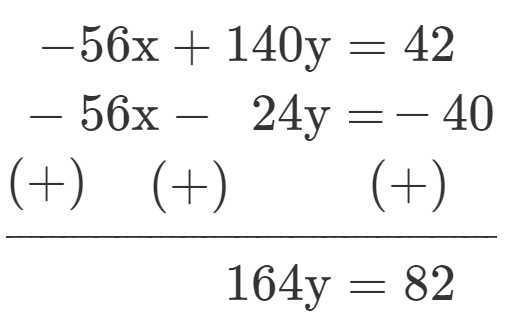
We know that, Three vectors are coplanar if one of the vector can be expressed as the linear combination of other two. Let, $5\vec{\text{a}}+6\vec{\text{b}}+7\vec{\text{c}}\\=\text{x}\big(7\vec{\text{a}}-8\vec{\text{b}}+9\vec{\text{c}}\big)+\text{y}\big(3\vec{\text{a}}+20\vec{\text{b}}+5\vec{\text{c}}\big)$ $5\vec{\text{a}}+6\vec{\text{b}}+7\vec{\text{c}}\\=7\vec{\text{a}}\text{x}-8\vec{\text{b}}\text{x}+9\vec{\text{c}}\text{x}+3\vec{\text{a}}\text{y}+20\vec{\text{b}}\text{y}+5\vec{\text{c}}\text{y}$ $5\vec{\text{a}}+6\vec{\text{b}}+7\vec{\text{c}}\\=\big(7\text{x}+3\text{y}\big)\vec{\text{a}}+\big(-8\text{x}+20\text{y}\big)\vec{\text{b}}+\big(9\text{x}+5\text{y}\big)\vec{\text{c}}$ Comparing the LHS and RHS, 7x + 3y = 5 .....(i) -8x + 20y = 6 .....(ii) 9x + 5y = 7 .....(iii) For solving (i) and (ii), Subtract -8 × (i) from 7 × (ii),
$\text{y}=\frac{82}{164}$ $\text{y}=\frac{1}2$ Put $\text{y}=\frac{1}2$ in equation (i), $7\text{x}+3\text{y}=5$ $7\text{x}+3\Big(\frac{1}2\Big)=5$ $7\text{x}+\frac{3}2=5$ $7\text{x}=\frac{5}1-\frac{3}2$ $7\text{x}=\frac{10-3}2$ $7\text{x}=\frac{7}2$ $\text{x}=\frac{7}{14}$ $\text{x}=\frac{1}{2}$ Now, put $\text{x}=\frac{1}{2}$ and $\text{y}=\frac{1}2$ in equation (iii), $9\text{x}+5\text{y}=7$ $9\Big(\frac{1}2\Big)+5\Big(\frac{1}2\Big)=7$ $\frac{9}2+\frac{5}2=7$ $\frac{14}2=7$ $7=7$LHS = RHS
$\therefore$ The value of x, y satisfy equation (iii).
So, $5\vec{\text{a}}+6\vec{\text{b}}+7\vec{\text{c}},\ 7\vec{\text{a}}-8\vec{\text{b}}+9\vec{\text{c}},\ 3\vec{\text{a}}+20\vec{\text{b}}+5\vec{\text{c}}$ are coplanar.
Need a full question paper?

Generate a complete, print-ready paper with questions like this in minutes — across 16+ boards, with answer keys.

Start Generating Free

Similar questions

$A$ bag contains $5$ red marbles and $3$ black marbles. Three marbles are drawn one bybone without replacement. What is the probability that at least one of the three marbles drawn be black, if the first marble is red?
Find the inverse of the following matrices by using elementry row transformation:$\begin{bmatrix}5 & 2 \\ 2 & 1 \end{bmatrix}$
Express the matrix $\begin{bmatrix}2&3&1\\1&-1&2\\4&1&2\end{bmatrix}$ as the sum of a symmetric and a skew-symmetric matrix.
Five defective mangoes are acciedently mixed with 15 good ones. Four mangoes are drawn at random from this lot. Find the probability distribution of the number of defective mangoes.
Find the length and the foot of perpendicular from the poin $\Big(1,\frac{3}{2},2\Big)$ to the plane 2x - 2y + 4z + 5 = 0.
$\text{Evaluate:} \int\limits_0^\frac{\pi}{2} (2\log \sin \text{x} - \log \sin 2\text{x}) \text{dx}$
If $(\cos\text{x})^{\text{y}}=(\tan\text{y})^{\text{x}},$ Prove that $\frac{\text{dy}}{\text{dx}}=\frac{\log\tan\text{y}-\text{y}\tan\text{x}}{\log\cos\text{x}-\text{x}\sec\text{y cosec y}}$
Explain if Rolle's theorem is applicable to any one of the following functions.
  1. $\text{f}(\text{x})=[\text{x}]\text{ on }\text{x}\in[5,9]$
  2. $\text{f}(\text{x})=[\text{x}]\text{ on }\text{x}\in[-2,2]$
Can you say something about the converse of Rolle's Theorem from these functions?
Solve the following differential equation:$4\frac{\text{dy}}{\text{dx}}+8\text{y}=5\text{e}^{-3\text{x}}$
If $\text{A}=\begin{bmatrix}3 & -3 & 4 \\ 2 & -3 & 4 \\ 0 & -1 & 1 \end{bmatrix},$ show that $A^{-1} = A^3.$