If $V_m$ is the velocity of sound in moist air, $V_d$ is the velocity of sound in dry air, under identical conditions of pressure and temperature
Easy


Download our appand get started for free
Experience the future of education. Simply download our apps or reach out to us for more information. Let's shape the future of learning together!No signup needed.*
Similar Questions
- 1The second overtone of an open organ pipe $A$ and a closed pipe $B$ have the same frequency at a given temperature. It follows that the ratio of theView Solution
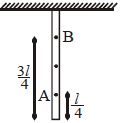
- 2A string of mass $m$ and length $l$ hangs from ceiling as shown in the figure. Wave in string moves upward. $v_A$ and $v_B$ are the speeds of wave at $A$ and $B$ respectively. Then $v_B$ isView Solution
- 3A point source emits sound equally in all directions in a non-absorbing medium, Two points $P$ and $Q $ are at distance of $2m$ and $3m$ respectively from the source. The ratio of the intensities of the waves at $P$ and $ Q$ isView Solution
- 4View SolutionWhen two sound waves are superimposed, beats are produced when they have
- 5A wire of density $9 \times 10^3 kg /m^3$ is stretched between two clamps $1 m$ apart and is subjected to an extension of $4.9 \times 10^{-4} m$. The lowest frequency of transverse vibration in the wire is ..... $Hz$ ($Y = 9 \times 10^{10} N / m^2$)View Solution
- 6At which temperature the speed of sound in hydrogen will be same as that of speed of sound in oxygen at $100\,^oC$ ..... $^oC$View Solution
- 7A whistle emitting a loud sound of frequency $540 \,Hz$ is whirled in a horizontal circle of radius $2 \,m$ and at a constant angular speed of $15 \,rad / s$. The speed of sound is $330 \,m / s$. The ratio of the highest to the lowest frequency heard by a listener standing at rest at a large distance from the centre of the circle isView Solution
- 8Two sound waves of wavelength ${\lambda _1}$ and ${\lambda _2}$ $\left( {{\lambda _2} > {\lambda _1}} \right)$ produce $n\, beats/s$, the speed of sound isView Solution
- 9Calculate the frequency of the second harmonic formed on a string of length $0.5 m$ and mass $2 × 10^{-4}$ kg when stretched with a tension of $20 N$ .... $Hz$View Solution
- 10An engine whistling at a constant frequency $n_0$ and moving with a constant velocity goes past a stationary observer. As the engine crosses him, the frequency of the sound heard by him changes by a factor $f$. The actual difference in the frequencies of the sound heard by him before and after the engine crosses him isView Solution